Welcome!

Thanks for visiting my blog! I hope it will serve to inspire you and perhaps inform you in some small way regarding the Holy Orthodox Faith or our Lord Jesus Christ. Feel free to comment or ask questions. Christ be with you!

Showing posts with label Orthodoxy. Show all posts

Thursday, January 17, 2013

Saint Anthony, Abbot, January 17

St. Anthony, Abbot, January 17


Saint Anthony of Egypt

The life of Saint Anthony (the authorship of which same is ascribed to Saint Athanasius) hath the following items regarding him who is venerated as the first Abbot of monks. Anthony was an Egyptian, the child of noble and Christian parents, whom he lost while yet very young. On one occasion he heard read in church this passage of the Gospel : If thou wilt be perfect, go and sell that thou hast, and give to the poor : and he straightway took these words as addressed to himself personally, and therefore distributed all his possessions to the poor. Since he was about to enter the field of battle against Satan, he first gave heed to the examples set by all those who were eminent for any grace, and strove to copy them. * He was excelled by none in watchfulness and self-restraint, and continual study of the Holy Scriptures. He had such a loathing of hereticks and schismatics, specially Arians, that he would never go near them. He slept lying on the ground. He took nothing with his bread but salt, and drank only water. He never ate or drank before sunset, and often abstained from food altogether for two days at a time. Very often he passed whole nights in prayer. And being so valiant a soldier of God, he was attacked by the devil with divers temptations. * He betook himself to the deserts round about Egypt, where many disciples became monks under his direction. Day by day the attacks of the fiends became more violent, but day by day his strength grew greater to strive against them. At length he came to mock at their powerlessness, saying : Satan is afraid of good men’s prayers and fasts, but above all for their warm love of our Lord, the mere Sign of whose holy Cross is enough to put him to flight. He became such an object of dread to the devils, that many persons tormented by them were delivered by calling on his name. Moreover, the fame of his holiness was so spread abroad that Constantine the Great and his sons wrote to him to commend themselves to his prayers. In the hundred and fiftieth year of his age, having roused up great numbers to follow his example, he passed to heaven, on January 17th, in the year 356.
Collect:
Grant, we beseech thee, O Lord, that the prayers of thy holy Abbot, blessed Anthony, may commend us unto thee, that we, who have no power of ourselves to help ourselves, may by his advocacy find favour in thy sight, through Jesus Christ our Lord. Amen.

Saturday, May 19, 2012

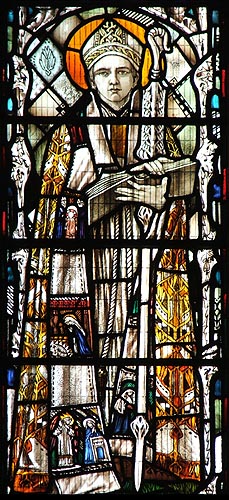
Saint Dunstan, Bishop and Confessor

Saint Dunstan, Bishop and Confessor

This Dunstan was born of a noble family. He was expelled from the king’s court through the efforts of his enemies, whereupon he bade farewell to the world, and betook himself to Glastonbury. As there were then no monks there, he got together some, of whom he was made Abbot. He was a great favourite of the Kings Edmund and Edred, but was peculiarly obnoxious to Edwy, because he had the courage often to rebuke this King for his perverse doings, and feared not to oppose his wishes. In consequence of his line of conduct, the King took proceedings against him, from which he was obliged to abscond. And he went and lived abroad at Ghent, in Flanders. * In the reign of Edgar he was called home again, with great popular applause, and soon afterwards promoted to the Archbishoprick of Canterbury. He was excessively severe in using Church discipline, and never spared one who had erred. He ejected all the married clergy from their churches, and put monks in their places, and forced the King himself to do penance for seven years of sins which he had committed. * Dunstan’s strictness caused him to be regarded with fear by many, but all admired him as a Saint, so that he got among the lower classes the name of being a good archbishop. After the death of Kings Edgar and Edward, he put the crown of Etheldred, the next heir, to whom he is said to have foretold an unhappy reign, and no cessation from trouble.


He died full of days, and was buried in his own Church, towards the end of the tenth century. He is reckoned the patron of gold-and silver-smiths, and also musicians, in that he ever laboured much and well, even with his own hands, for ecclesiastical decencies in worship.


Collect:
O God, who didst exalt blessed Dunstan thy Bishop to thy heavenly kingdom, grant, we beseech thee, that by his glorious merits we may attain to everlasting felicity, through Jesus Christ thy Son our Lord. Amen.

Thursday, January 19, 2012

Saints Maris, Martha, Audifax, and Habakkuk, Martyrs

Saints Maris, Martha, Audifax, and Habakkuk, Martyrs, January 19


Maris was a Persian of high rank, who came to Rome in the reign of the Emperor Claudius, with his wife Martha, who was equally noble, and their two sons Audifax and Habakkuk, to pray at the graves of the martyrs. Here they comforted the Christians who were in prison, (whom they relieved by their ministrations and alms,) and buried the bodies of the Saints. For these good deeds they were all arrested, but no threats or terrors could move them to sacrifice to idols. They were accordingly beaten with clubs, dragged about with ropes, burnt with red-hot metal, and mangled with metal hooks. Lastly their hands were all cut off, and they were fastened together by the neck, in which state they were driven through the City to the Thirteenth Milestone on the Cornelian Way, a place now called Santa Ninfa, where they were to die. There Martha addressed a moving exhortation to her husband and sons to hold out bravely to the last, for the love of Jesus Christ, and was then herself drowned. The other three martyrs were next beheaded, and thrown into a fire. The lady Felicity of Rome collected the half burnt remains, and caused them to be buried at her won farm. The date of their death was in the year 270.


Collect:
O Lord, we pray thee, graciously to hear thy people that call upon thee with the assistance of thy Saints, that we may obtain of thee peace in this our temporal life, and likewise thy succour unto life eternal, through Jesus Christ thy Son, our Lord, who liveth and reigneth with thee and the Holy Ghost, ever one God, world without end. Amen.

Wednesday, January 18, 2012

Saint Prisca, Virgin and Martyr, January 18


St. Prisca, Virgin & Martyr
Saint Prisca, Virgin and Martyr, January 18

This Saint Prisca hath been venerated in Rome from the very earliest times as a Virgin and Martyr. She was a maiden of noble lineage who, at the age of thirteen, was accused before the Emperor Claudius, but remained faithful to Christ in spite of the most barbarous tortures inflicted on her pure body. And that finally she was beheaded, namely, about the year 250, and buried by the Christians on January 18th, at the Tenth Milestone from the City. The basilica erected in her honour came later to bear the title : Saints Aquila and Priscilla : which Saints are commemorated in the Martyrology on July 8th, and are mentioned several times in the New Testament, and were friends of the Apostle Paul. But it was the practice of early days to draw together, for commemoration on the same date, the memories of those blessed ones who had the same name, for which reason in some places the holy Priscilla, who was the friend of Saint Paul, is honored on this day, and holy Aquila as well.


Collect:
Grant, we beseech thee, Almighty God, that we, who this day observe the heavenly birthday of blessed Prisca thy Virgin and Martyr, may in such wise rejoice in her yearly festival, that we may learn to follow rightly the pattern of her faith, through Jesus Christ our Lord. Amen.

Monday, January 16, 2012

Saint Marcellus, Pope and Martyr, January 16

St.Marcellus in a stable
Saint Marcellus, Pope and Martyr, January 16,


This Marcellus was a Roman, and was believed to have held his brief pontificate in the reign of Constantius and Galerius, and in that of Maxentius. According to the Pontifical Book, it was through his persuasion that the Roman Lady Lucina left the whole of her property to the Church of God, which same was made into a church bearing his name. An epitaph by Pope Saint Damasus saith that because of his enforcement of the penitential canons, he excited the wrath of Maxentius, who threatened him with punishment. * The servant of God treated with contempt the mad cries of this man, who (so it is said) sent him to a menagerie, to take care of the beasts which were fed at the public cost, where Marcellus remained in continual fasting and prayer. And, as he could not visit the parishes of Rome in person, he wrote letters to them, until some of his clergy rescued him. * Maxentius, it is said, thereupon had the wild beasts brought from the menagerie and located in a church, where Marcellus was made to feed them. And the noisomeness of the place and the filthiness of his occupation soon broke down a constitution already enfeebled by many ailments, and he fell asleep in the Lord in 309, on January 16, and for his sufferings is accounted a Martyr.


Collect:
O Lord, we beseech thee favorably to hear the prayers of thy people, that, as we do rejoice in the passion of thy blessed Bishop and Martyr, Saint Marcellus, so his merits may be our succour and defence, through Jesus Christ our Lord. Amen.

Saturday, January 14, 2012

Saint Hilary of Poitiers

Saint Hilary of Poitiers, Bishop, Confessor & Doctor

Hilary was born of a most illustrious family in Aquataine, and of him blessed Jerome saith : He was a man of mighty eloquence, the Latin Trumpet against the Arians. He was born of pagan parents , and brought up in idolatry, but in due time was found of Christ and became God’s servant. In early life he had married, but at his ordination he and his wife chose to live in continence. And because of the fame he made for himself by his wisdom and eloquence as a priest, he was chosen to be Bishop of Poitiers, in which office he gained the universal praise of the faithful. At that time the Emperor Constantius was persecuting the Catholics by every species of cruelty, in order to make them yield to the Arian heresy. Against the Arians Hilary set himself up as a brazen wall, and thereby turned upon himself the fierceness of their anger. When they procured his banishment to Phrygia, he used his exile to write a work in twelve books, on the Trinity, against these hereticks. * In the year 359, the fourth of his exile, he was obliged to attend the Council of Selucia in Isauria, which was largely composed of Arians, whom he there publicly withstood. And afterwards he withdrew to Constantinople, where he demanded leave from the Emperor to hold a public disputation in his presence. However, the Arian Bishops Ursacius and Valens, whom Hilary had already confuted in writing, were afraid to meet him in debate, and therefore induced Constantius, under pretence of pardon, to send him back to his bishoprick. And he was followed to Poitiers by Martin, afterwards Bishop of Tours, whose growth in holiness was a fruit of his teaching. * Henceforth he ruled the Church of Poitiers in great peace. His wonderful learning is seen in his numerous written works. And his tenderness of heart is well manifested in a letter, still extant, which during his exile he wrote to his daughter, urging upon her to become a nun, which same by this letter she was moved to do. He passed from earth to heaven upon January 13th, about the 368, during the reign of the Emperors Valentian and Valens. He has been called an Illustrious Doctor of the Church by many Fathers and Councils.


The Collect:
O GOD, who hast enlightened thy Church with the wondrous learning of blessed Hilary thy Confessor and Doctor: mercifully grant to us thy servants; that we, being in all things enlightened by his wisdom, may at all times feel the effectual succour of his righteousness. Through Jesus Christ our Lord. Amen.

Wednesday, November 30, 2011

Saint Andrew the Apostle, November 30

Saint Andrew the Apostle


Saint Andrew the first called
The Apostle Andrew, who was blood-brother to Peter, was born at Bethsaida, a town of Galilee. He first became a disciple of the Baptist. But when he heard John say : Behold the Lamb of God : he straightway became a disciple of Jesus, to whom he brought his brother Peter also. Some while after, when they went fishing in the Sea of Galilee, the Lord Christ came by and called them both, before any other of the Apostles, in the words : Follow me, and I will make you fishers of men. Whereat without delay they left their nets, and followed him. After the death and resurrection of Christ, according to the ancient historian Eusebius, Andrew was allotted European Scythia as the province of his preaching Other ancient writers say that he went through Epirus and Thrace, and there turned many souls to Christ by his teaching and wondrous works. Finally he is said to have gone to Patras in Achaia, and to have brought many there also to the knowledge of Gospel truth. The particulars of his death were written down by the priests and deacons of Achaia, which same were eye-witnesses of his last sufferings. According to this account, when Aegeas the Proconsul resisted the preaching of the Gospel, the Apostle freely rebuked him, bidding him know that whilst he set himself up as a judge of his fellow men, he was himself in such wise deceived by evil spirits that he was unable to recognize the divine Judge of all men in the person of Christ.
And according to the aforementioned record, blessed Andrew’s martyrdom was on this wise. Aegeas answered the Apostle wrathfully, saying: Boast no more of this matter, for thy Lord Christ spake words even such as thine, but they availed him not, and he was crucified by the Jews. Whereto Andrew boldly answered that Christ of his own will had given himself up to die for man’s salvation. But the Proconsul with blasphemy interrupted him, and bade him look to his own interests ; and if he would save himself, to sacrifice to the gods. Then said Andrew : We have an altar, whereon day by day I offer up to God Almighty, the one and only true God: not the flesh of bulls nor the blood of goats, but a Lamb without spot ; and when all they that believe have eaten of the Flesh thereof, the Lamb that was slain abideth whole and liveth. Then Aegeas, filled with wrath, bound the Apostle in prison. Now the people could easily have accomplished his deliverance, were it not that he himself calmed them, and earnestly besought them not to take from him the crown of martyrdom, for which he longed, and which was drawing near.
And it is said that a short while thereafter, Andrew was brought before the judgement-seat, where he extolled the Mystery of the Cross, and again rebuked Aegeas for his ungodliness. Whereupon Aegeas would bear with him no longer, but commanded him to be crucified, in imitation of Christ. Then was Andrew led to the cross. And when as yet he saw it afar off, he cried out : O gracious cross, made so fair and goodly by the sweet body of my Lord! Long have I desired thee! Constantly have I sought thee! And now that thou art made ready, my soul is drawn to thee! Welcome me from amongst men, and join me anew to my Master, that as by thee in death he redeemed me, so by thee he may take me unto himself once and for all! So he was fastened to the cross, whereon he hung living for two whole days, during which time he ceased not to preach the Faith of Christ, and finally, passed into the presence of him the likeness of whose death he had loved so well. Under the Emperor Constantine the relicks of the Apostle were first taken to Constantinople, whence they were afterwards brought to Amalfi. But in the pontificate of Pope Pius II his head was carried to Rome, where it is kept in the Basilica of Saint Peter, that the relicks of these two blood-brothers might be nigh each other. Blessed Andrew is revered as the Patron of Scotland and Russia, and his name is twice read in the Gregorian Canon ; namely, first in the Canon proper, and secondly in the Embolism.
 
Antiphon of the Magnificat:
One of the two which followed the Lord was Andrew, * Simon Peter’s brother, Alleluia.
Collect:
Almighty God, who didst give such grace unto thy holy Apostle Saint Andrew, that he readily obeyed the calling of thy Son Jesus Christ, and followed him without delay : grant unto us all , that we, being called by thy holy Word, may forthwith give up ourselves obediently to fulfil thy holy commandments, through the same Jesus Christ our Lord. Amen.
Antiphon on the Benedictus:
And the bystanders pleaded for him: Spare this innocent man! Restore to us this holy one! Slay not him that is so dear to God! * for he is just and meek and godly.

A Homily by Saint Gregory the Pope

Dearly beloved, ye have heard how Peter and Andrew, at one word of command, left their nets, and followed their Saviour. As yet they had seen none of his miracles. As yet they had received no promise of their eternal and exceeding great reward. Nevertheless, at one word from the Lord they forgat all those things which they seemed to have. We on the contrary have seen many of his miracles. We have received many of his gracious chastenings. Many times hath he warned us of the wrath to come. How is it then that when the Lord calleth we do not follow?
Christ who calleth us to be converted is now enthroned in heaven. He hath bowed the necks of the Gentiles under the yoke of the Faith. He hath laid low the glory of the world, and the ruins thereof on all sides do preach unto us that day when he is to be revealed as our Judge is drawing nigh. Yet so stubborn is our mind that we will not freely abandon what willy nilly we are each day losing. Dearly beloved, what shall we answer at his judgement-seat, we whom no lessons can persuade and no stripes can break from the love of this present world?
Some one perchance will ask in his heart, what these two fishermen had to lose by obeying the call of the Lord? Dearly beloved, we must consider here the intention, rather than the loss incurred by this obedience. He that keepeth nothing for himself giveth up much. He that sacrificeth his all, sacrificeth what is to him a great deal. Beyond doubt, we cling to whatever we have, and what we have least, that we desire most. Peter and Andrew therefore gave up much when they gave up even the desire of possessing anything.

Friday, August 5, 2011

Aug 5th, Saint Oswald, King and Martyr

Saint Oswald, King and Martyr

Oswald was the son of Ethelfrid the Ravager, King of the Northumbrians. After his father had been slain in battle by Redwald, King of the East Angles, he was carried into exile in Scotland, where he was taught the Faith of Christ and baptized. When he returned to his own country he found Cadwalla, King of the Britons, pitifully wasting everything. This Cadwalla had already slain three kings of the English, and was seeking to destroy all of that nation. Oswald gathered together a small army and, placing his trust in God, bravely attacked the countless hosts of the enemy. Before he joined battle he set up he standard of the Cross of the Lord with his own hands, knelt down, and prayed God to help a righteous war for the saving of the fatherland. He exhorted all his soldiers to do likewise, and so they did ; and all promised that if God granted them the victory they would believe in him who had been crucified. Thereupon they obtained an easy victory, and crushed the tyrant with all his legions. And the place where the Sign of the Cross was set up was afterwards called in the English language Heaven's Field ; and pieces of wood of this cross which Oswald erected were believed to have been the occasion of many miracles in later times.

Oswald being thus placed in possession of his kingdom was fain that all nations should receive the grace of Christian belief. Hence he sent forthwith into Scotland, praying them to send him a bishop, by whose teaching and ministry the English people might receive the Faith and Sacraments of Christ. Whereupon there was sent unto him blessed Aidan, unto whom the King granted at his own prayer the Island of Lindisfarne to be the See of his Bishoprick. After Aidan came many other Gospel-preachers, especially from the Island of Iona. By their preaching and the support given to them from the godliness and zeal of the King, Christ's own kingdom was wonderfully spread abroad in all the country between the Humber and the Forth ; churches were built in divers places, schools set up for the teaching of children, and monasteries founded by the King's bounty, so that the English might learn not only the greater studies but also the institutes of regular discipline. The King himself listened to the preaching of Aidan, and humbly and cheerfully granted all his wishes, and by his own illustrious example did much to set forward the cause of the Church throughout all his dominions. Now Aidan could not speak English well, and when he was preaching the Gospel there could often be seen the lovely spectacle of the King himself interpreting the heavenly Word to his own officers and servants.

Thus did this most devout King Oswald shew himself a loyal and ready subject of the eternal King of kings, and by this he was glorified as regards his temporal dominion more than all that had been before him, so that nearly all the provinces of all Britain came under his sway ; and nevertheless he was never tainted with pride, but was always lowly, kindly, and open-handed to Christ's poor and to strangers. When he had happily reigned for eight years he was encompassed in battle by heathen rebels ; and when he saw that he was bound to perish, he called for the divine mercy for himself and for the souls of them that were about to slay him ; namely, in the year of Christ 642, and of his own age the thirty-eighth, upon the 5th day of August, upon the which day mention is made of his memory in the Martyrology. How precious was his death in the sight of the Lord became afterwards manifest by countless miracles obtained through his intercession.


Collect:

Almighty and everlasting God, who hast hallowed this day to be a day of gladness and rejoicing by the Martyrdom of thy blessed Saint King Oswald : we pray thee, pour into our hearts such an increase of thy charity, that like as we do honour his glorious battle for thy Faith, so we may imitate him in constancy even unto death. Through Jesus Christ, thy Son our Lord, who livest and reignest with thee, in the unity of the Holy Ghost, ever one God, world without end. Amen.

Aug 5th, Our Lady of the Snows

Our Lady of the Snows

This feast is in commemoration of the first church to be dedicated in Rome under the invocation of our Lady, and the third of those Christian temples in the City known as Patriarchal Basilicas. The origin of this building, according to an old story, popular in ancient times, was as followeth. In the middle of the fourth century, during the pontificate of Pope Liberius, there lived at Rome a certain nobleman named John, and a noble lady his wife, who had no children to whom to leave their substance, and who vowed that they would make the holy Virgin Mother of God their heiress. And earnestly they besought her in some way to make known to them upon what godly work she would have their money spent. And thereupon (so saith the story) the blessed Virgin graciously listened to the heart-felt earnestness of their prayers, and by a wondrous sign assured them of her will.


On the fifth day of August, which is the time when the heat of summer waxeth greatest in Rome, a part of the Esquiline Hill was covered at night with snow. And some scholars think that such a strange and unseasonable fall of snow did take place, and so gave rise to the old tale, which goeth on to say on this same night the Mother of God appeared in a dream to John and his wife separately, and told them that on that spot, which in the morning they could see clad in snow, they should build a church, to be dedicated under the name of the Virgin Mary, for that this was the way in which she chose that they should make her their heiress. Then John went and told it to Pope Liberius, who declared that he also had been visited by a like dream.

Therefore Pope Liberius went in a solemn procession of clergy and people to the snow-clad hill, and traced upon that spot the plan of the church, which same was afterwards built with the money of John and his wife. And later it was rebuilt by Saint Pope Sixtus III. At the beginning it was called by divers names, sometimes the Liberian Basilica, sometimes the Church of Saint Mary-at-the-Manger (because of the presence there of a relick revered as the Manger in which our infant Lord lay), and so on. Howbeit, since there are in Rome many churches called after the holy Virgin Mary, and this church, both in age and dignity, doth excel them all, it is commonly called St. Mary Major. And the memory of the dedication there of is kept every year by this feast-day that taketh name from the strange fall of snow which is said to have taken place on this day.


Collect
O
Lord God Almighty, we beseech thee to keep us thy servants both outwardly in our bodies and inwardly in our souls : that by the glorious intercession of blessed Mary Ever-Virgin, we may be defended from our present heaviness and attain in the end to everlasting gladness. Through Jesus Christ, thy Son our Lord, who livest and reignest with thee, in the unity of the Holy Ghost, ever one God, world without end. Amen.

Tuesday, August 2, 2011

August 2nd, Saint Stephen, Pope and Martyr


August 2nd, Saint Stephen, Pope and Martyr
This Stephen was a Roman, who became Pope in 254, and fulfilled his office during the reign of the Emperors Valerian and Gallienus. His short Popedom was made notable by the controversy over the re-baptism of those christened by hereticks. Such re-baptism he forbade, and wrote to Saint Cyprian in these words : Let us have no innovations, but only what hath been handed down unto us. No sure or certain records of his martyrdom exist. But tradition saith that as persecution was waxing dreader and more dread, Stephen gathered together the clergy, and exhorted them to be brave in lifting up their testimony, and himself celebrated Masses and Councils in the Catacombs ; and that finally, whilst he was one day finishing the Mass, the soldiers of the Emperor brake in upon the Christians and cut off Stephen’s head as he sat in his chair; and that the relicks of the Martyr along with the chair stained with his blood, were buried by the clergy in the cemetery of Saint Callistus, upon the second day of August in the year 257. According to the Pontifical Book, he lived as Pope three years, three months and twenty-two days, and held two December ordinations, and in them ordained six priests, five deacons and three bishops.

Collect:

Be merciful to the people of thy flock, O Lord, eternal Shepherd and Bishop of the souls of men : and keep us in thy continual protection ; at the intercession of thy blessed Martyr, the Holy Father Stephen, whom thou didst raise up in thy Church to be thine under-shepherd, through Jesus Christ our Lord, who liveth and reigneth with thee and the Holy Ghost, one God world without end. Amen.

Saturday, July 30, 2011

July 30th, Saints Abdon and Sennen, Martyrs

July 30th, Saints Abdon and Sennen, Martyrs


Abdon and Sennen, as we know from ancient records, were Persians who suffered for Christ at Rome, probably under Diocletian, early in the fourth century. For their feast was already kept in the City in the year 354. It is believed that they had been brought to Rome either as hostages, or as prisoners of the Emperor, after his campaign in their country. In later days it was said that they were apprehended in Rome on the charge that they had interred, on their own farm, the bodies of Christians, which had been thrown out unburied. Whereat they were ordered to sacrifice to the gods, which they refused to do, and so were put into strict confinement. And afterwards when the Emperor returned to Rome, he had them led in chains in his triumph. And being thus dragged into the City and up to the idols, they spat upon them, for which they were cast to bears and lions. And because the beasts were afraid to touch them, they were butchered with the sword. And their corpses, with their feet bound together, were dragged before the image of the sun. Thereafter their remains were stolen away, and Deacon Quirinus buried them in his own house.

Collect:

O God, who on thy servants Abdon and Sennen didst bestow abundant grace to attain unto the crown of glory : grant unto thy servants the remission of all their sins ; that, by the intercession of the merits of thy Saints, they may be found worthy to be defended against all adversities, through Jesus Christ our Lord. Amen.

Thursday, July 28, 2011

Saints Nazarius & Celsus, Martyrs. Victor I, Pope & Martyr & Innocent I, Pope & Confessor

Saints Nazarius & Celsus, Martyrs. Victor I, Pope & Martyr & Innocent I, Pope & Confessor


Nazarius and Celsus were early venerated at Milan as Martyrs, and there blessed Ambrose searched for their remains and believed that he had found them. Nazarius was baptized by Saint Pope Linus, and afterwards went to Gaul. Where he met with the boy Celsus, whom he instructed in the Faith, and baptized. Therefore these twain went to Treves, and in Nero’s persecution were both thrown into the sea, whence they had a marvellous escape, and fled to Milan, where they spread the Faith, for which they were apprehended and beheaded, and buried outside the Roman Gate. There their bodies lay unknown and unhonoured till blessed Ambrose found them, and laid them in an honorable sepulchre in Milan. * Pope Victor I was by birth an African, and governed the Church under the Emperor Severus. To his efforts it is chiefly due that the Western Church came to agreement in the celebration of the paschal feast by our present method of reckoning. But Saint Irenaeus interceded with him, that he would not provoke into schism certain of the Church whose custom in this matter was different. He is reputed also to have decreed that , if need be, Baptism can be administered with any water, so long as it be natural. He cast out of the Church Theodotus the Tanner, who came from Constantinople, and taught that Christ was nothing but a man. He wrote upon the subject of the Passover, and composed some other small works. According to the Pontifical Book, he held two December ordinations, wherein he made four priests, seven deacons, and twelve bishops for divers places, and sat in the Chair of Peter nine years, on month and twenty-eight days. He is believed to have received the crown of his testimony, and his burial on Vatican Hill, on July 28th, about the year 197, and by tradition is revered as a Martyr. * Pope Innocent I flourished in the days of Saints Jerome and Augustine, when the times were troublous, and Alaric sacked the Eternal City; on behalf of which he had gone to get the help of the Emperor Honorius at Ravenna, whereby the man of God escaped the grief of seeing the destruction of the Roman people, even as righteous Lot, by God’s providence, escaped the burning of Sodom. This holy Pope was a vigorous administrator of the duties of his office, whereby he left his mark on Christianity for all time. He it was who condemned Pelagius and Caelestius, and made a decree against their heresy, ordering that little children even those whose mothers were Christians, must be born again in Baptism, that their original sin might be done away. Numerous other notable things were done by him. For he befriended and protected holy John Chrysostom. He wrote letters containing prudent decisions which are now observed as laws. To the Bishop of Tolouse he wrote that absolution and holy Communion is never to be denied to dying penitents. To the Bishop of Gubbio he wrote that bishops only (because they alone have the fulness of the priesthood) are administer Confirmation. According to the Pontifical Book, he sat in the throne of Peter fifteen years, one month, and ten days, and held four December ordinations, wherein he made thirty priests, fifteen deacons, and forty-four bishops for divers places. He went to God on March 12th, 417, and was buried in the cemetery known as the Place of the Bear-and-the-Cap, but is honored on the reputed date of his translation.

Collect:

We pray thee, O Lord : that the glorious confession of thy blessed Saints, Nazarius, Celsus, Victor, and Innocent, may strengthen us against all temptations, and obtain for the frailty of our mortal nature the succour of thy bounteous goodness, through Jesus Christ our Lord. Amen.

Wednesday, July 27, 2011

July 27th, Saint Pantaleon, Martyr.


July 27th, Saint Pantaleon, Martyr.


Pantaleon (whose name by interpretation is The-All-Compassionate) died the death of a martyr, as Theodoret and others do testify, and the year thereof was probably 305. Little more than this is certainly known of him, but in after years his story came to be told on this wise. He was of a noble family of Nicomedia, a learned man and a Christian, who became the physician of the Emperor Galerius Maximian. At whose wicked court he was seduced into sin, and became an apostate. But when he had been brought back to Christ by a zealous Christian named Hermolaus, he gave all that he had to the poor, and out of his great compassion served them without pay. Whereat he was denounced as a Christian by some jealous fellow-physicians, and put to the torture under the Emperor Diocletian ; first on the rack, and then by searing of his body with red-hot metal, and in divers other ways. All which bitterness of suffering he bore with a quiet and brave heart, and at last received the stroke of the sword, and the crown of martyrdom. He is counted as one of the Fourteen Holy Helpers, being venerated as a patron of the sick and those who care for them. In the east he is entitled : Great Martyr and Healer : and is numbered along with Saints Cosmas and Damian, among those known as The-Holy-and-Moneyless-Physicians, which three saints all Catholics do honour, next after Luke the Beloved Physicians, and Patrons of medical men.

Collect:

Grant, we beseech thee, Almighty God : that by the prayers of thy holy Martyr blessed Pantaleon, we may be delivered from all adversities which may happen to the body, and from all evil thoughts which may assault and hurt the soul, through Jesus Christ our Lord. Amen.

Saturday, July 23, 2011

July 23rd, Saint Apollinaris, Bishop & Martyr

July 23rd, Saint Apollinaris, Bishop & Martyr


Apollinaris was the first to be Bishop of Ravenna, and Saint Peter Chrysologus, the most illustrious of his successors, in a sermon which hath come down to us, referred to him as a Martyr, but added that although he frequently shed his blood for Christ, his persecutors did not take away his life. However, he was venerated in the early days as one f the greatest of Martyrs, and it is therefore to be presumed that he suffered much and often for Christ. * The Book of his Acts saith that he came to Rome along with blessed Peter, and that the Apostle himself consecrated him as bishop, and sent him to Ravenna to preach the Gospel, where he converted many to the Christian Faith. For which the idolatrous priests caught him and gave him a sharp flogging. Whereafter a second riot was got up against him because he healed Boniface, a nobleman who had long been dumb, and delivered his daughter from an unclean spirit. On this occasion Apollinaris was flogged again, and made to walk barefoot over hot embers, and them expelled from the city. Whereupon he hid for a while with certain Christians, and afterwards went to Emilia, where he brought many to Christ. For which the ruler of that city also had him driven from place to place and country to country, until he was thus driven back to Ravenna, where he was denounced by the same idolatrous priests as before. * After which things Apollinaris fled away again, but was followed after, and caught and beaten, and left for dead by the roadside, where some Christians found him, and took him and cared for him, so that he lived seven days, exhorting them to stand firm in the Faith. And so he departed this life with the glorious splendour of martyrdom, and his body was buried hard by the wall of the city.


Collect:

O God, who rewardest the souls of the faithful, who hast likewise made this day holy with the martyrdom of thy blessed Priest Apollinaris : grant, we pray thee, that we thy servants, who here observe his solemn festival, may by his intercession obtain the pardon of thy mercy, through Jesus Christ our Lord. Amen.

Thursday, July 21, 2011

July 21st, Saint Praxedes, Virgin.

Apse of the Church of St. Praxedes
July 21st, Saint Praxedes, Virgin.


This Praxedes (as we know from ancient records ) was a maiden of Rome in the second century who was buried in the Cemetery of holy Priscilla, next to the maiden Pudentiana, who is therefore reputed to be her sister, and whose Legend is given on May 19th. The story that hath been told for many centuries concerning Praxedes is that she constantly assisted with money, labour, comfort, and every helpful office of Christian charity, all those Christians whom the Emperor Marcus Antoninus was at that time hunting down like wild beasts. Some she his in her house, some she exhorted to firmness in professing the Faith, of some she buried the bodies. For those in prison, and those toiling in slavery, she supplied every need. At last the sight of such butchery of Christians was more that she could bear, and she implored God that she might die, if it were expedient for her so to do, and to be released form such suffering. And on July 21st, she went to god. Whereupon Pastor the Priest, so it is said, laid her body in the double-grave of her father and sister, and Saints Pudens and Pudentiana, in the cemetery of Saint Priscilla.


Collect:
Graciously hear us, O God of our salvation : that, like as we do rejoice in the festival of thy blessed Virgin Saint Praxedes, so we may learn to follow her in all godly and devout affections, through Jesus Christ our Lord. Amen.

Wednesday, July 20, 2011

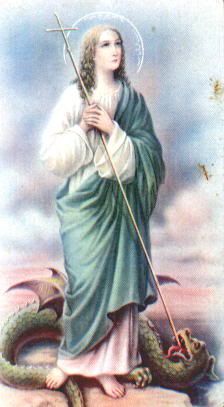
July 20th, Saint Margaret of Antioch, Virgin and Martyr


St.Margaret of Antioch
 

July 20th, Saint Margaret of Antioch, Virgin and Martyr


This Margaret is one of the most widely venerated Saints of the Church East and West, who suffered death for Christ at Antioch. In the East she is called The Great-Martyr Marina, which name, like Margaret, signifieth a pearl ; and her feast is kept on July 12th. From the East her fame spread to the West, and in the seventh century her name, changed to Margaret, appeared in an English Litany. During the middle ages she came to be much beloved throughout Europe, being invoked against demoniac possession, and by women in childbirth, and by those who were fearful. In 908 her relicks were stolen from Antioch, and brought to Europe, and finally enshrined in the Cathedral of Monte-fiascone. * According to the late compiled volume of her Acts, she was bon at Antioch in Pisidia, her father being the heathen priest Aedesius, which same put her out to nurse with a Christian woman. From her she learnt Christ, whereupon her father would have none of her. And so she was forced to make her living as a shepherdess, and was seen by the Prefect Olybrius, who for her rare beauty desired her to wife, if she were a free woman, but sin with, if she were a slave ; but she would have nothing to do with him. At his judgement-seat she was questioned by him thus : What is thy name and birth and religion? To whom she answered : Margaret is my name ; I am of noble birth ; and by religion I am a Christian. * Then said the Prefect : The first and second answers befit thee, but the third is a folly, for who can make a god out of one crucified? To whom the Virgin replied : Whence didst thou learn that the Lord Jesus was crucified? To which the Prefect answered : Out of the books of the Christians. And Margaret made answer : Is this thy wisdom? That when in the same books both the passion and glory of Christ are witnessed to thou dost believe one and reject the other? Whereupon she was tried with all kinds of tortures ; and in the darkness of her prison it seemed to her that the devil came as a great and swallowed her up, but could not stomach the cross which she carried, and therefore spewed her forth. And other spiritual trials and agonies came to her during her physical conflict; but in her patience she in such wise possessed her soul in Christ that many came to believe in him ; whereupon she went in triumph to him her Spouse by beheading, namely, in the reign and persecution of Diocletian, early in the fourth century.

Collect:
Grant, O Lord, that, like as blessed Margaret, thy Virgin and Martyr : by the merits of her chastity and godliness of conversation did ever walk acceptably in thy sight ; so she may at all times effectually intercede for our forgiveness, through Jesus Christ our Lord. Amen.

Monday, July 18, 2011

July 17th, St. Symphorosa and her seven sons, Martyrs.

July 17th, St. Symphorosa and her seven sons, Martyrs.


Church of the Holy-Angel-in-Fish-Market

Symphorosa was martyred on July 18th, about the year 135. And at that time seven young men, who died for Christ, were in such wise associated with her testimony that they have ever since been called her sons, albeit it is no longer known whether she mothered them in the flesh or only in the spirit like unto the similar case of the Seven Holy Brethren and blessed Felicity. Symphorosa is reputed to have been a woman of Tivoli, the wife of the Martyr Getulius. And such a mother in Israel was she that these seven young men (who, if they were not brethren because of common blood, were brethren by the blood which they shed in common for Christ), were constrained by her faith to persevere unto death. And it is no longer certainly known how they died. But it is said that a stone was tied to the neck of Symphorosa, and that she was then thrown into the river, and that afterwards her body was found by one of her family. Of he seven sons, however, it is related that they were tied each to a stake, and all pt to death in divers ways. Crescens, the eldest was stabbed in the throat ; Julian in the breast ; Nemesius in the heart ; and Prinitivus in the navel. Justin was hacked limb from limb. Stacteus was shot to death with darts. Eugene was cut into two parts across his breast, from the head downwards. Thus, so it is said, were these sacrifices of sweet savour offered to God. Their bodies were thrown into a deep pit, on the road between Rome and Tivoli, at the Ninth Milestone from Rome, but were afterwards brought to Rome and buried in the Church of the Holy-Angel-in-Fish-Market.


Collect:

O God, who vouchsafest unto us to keep the heavenly birthday of thy holy Martyrs Symphorosa and her sons, grant, we beseech thee, that we may rejoice in the perpetual felicity of their friendship, through Jesus Christ our Lord. Amen.

Saturday, July 16, 2011

July 17th, Saint Alexius, Confessor


July 17th, Saint Alexius, Confessor


Early in the fifth century there lived in Edessa, Syria, a beggar. Which same was of such sanctity that he was revered as a Saint, and was known by no other name than The-Man-of-God. Sometime after his death, probably between the years 450 and 475, and unknown writer wrote an account of him. Wherein we are told that he lived by begging at church doors, and that he shared the alms with other poor folk, and himself existed on what little was left when their needs were supplied. And when he died, he was buried in the potter’s field of Edessa. But before his death he confided to the man that was nursing him that he was a member of one of the noblest Roman families. A later rescension of this book saith (on what authority no one knoweth) that his name was Alexius. And that from his penitent love for Jesus Christ, he received a particular command from God not to touch the bride that he was about to take unto himself, but rather to undertake a pilgrimage to the most famous churches of the world. So that for many years he remained occupied in these journeys and utterly unknown. In the course of which he came back to Rome, and fared to the house of his won father. Who knew him not, but gave him shelter in a space under the stairs leading up to the house, where he lived unrecognized by any for many years. Who by such a hard and hidden penitent life sheweth unto worldlings that God hath servants who have loved Christ Jesus with a love passing that of women, for which same they count the world well lost.

Collect:
O God, who makest us glad with the yearly feast of blessed Alexius, thy Confessor, mercifully grant, that, as we now observe his heavenly birthday, so we may follow him in all virtuous and godly living, through Jesus Christ our Lord. Amen.

July 15th, Translation of Saint Swithun, Bishop and Confessor


Translation of Saint Swithun, Bishop and Confessor


Swithun entered the monastery of Winchester, and became a priest therein. King Egbert of the West Saxons heard of his fame and gave his son Ethelwulf into his care ; and when this prince years afterwards succeeded to the kingdom, he nominated Swithun Bishop of Winchester, with the consent of the Archbishop of Canterbury and his clergy. Thereafter, in his duty towards his See, Swithun left nothing undone which is the part of a faithful shepherd. * He shrank from all display and gaining of glory in the sight of men, and desired nothing more than that all the good which he did should be unknown save to God and to his own conscience. When he was dying, (to wit, on July 2nd, 862,) he expressed the wish that his body should be laid in the earth outside the church, under the open sky, that the feet of them that came thither might pass over him, and that the rain and the dew might fall upon him ; and his lowly wish was carried out. * Wherefrom hath spring the belief that because of his love of both sunshine and rain, God doth ever grant his request for either, whichever he preferreth for his feast day, and for forty days continuously thereafter. But when the new Cathedral Church of Winchester was built, the relicks of blessed Swithun were translated thereto, to wit, in 1093.

Collect:

Almighty and everlasting God, who hast made this day honorable unto us by reason of the festival of blessed Swithun thy Confessor and Bishop : grant, we beseech thee, that thy Church may so rejoice in this solemnity, that e which on this day do honour him on earth may by his intercession obtain thy succour in heaven, through Jesus Christ thy Son our Lord, who liveth and reigneth with thee and the Holy Ghost, one God, world without end. Amen.

Friday, July 15, 2011

July 15th, Saint Henry, Emperor and Confessor

Saint Henry, Emperor and Confessor.


Henry II, surnamed the Good, was born in 972, and became successively Duke of Bavaria, King of Germany, and Emperor of the Holy Roman Empire, of which he was one of the best and holiest of rulers.  Some say that he once wished to become a monk, and vowed obedience to the Abbot of Verdun ; whereupon the Abbot put him under obedience to retain his royal power, and use it always for the extension of God's kingdom.  As Emperor, he earnestly set himself to the furtherance of the cause of godliness.  He restored churches which had been ruined, built and endowed monasteries, founded new dioceses, and ordered various synods of bishops to assemble, and legislate for the better ordering of things ecclesiastical.  * He waged many wars, some against oppressors of the Church, some for the consolidation of the Empire, but all against injustice.  He made frequent visitations throughout his dominions to relieve the poor, prevent oppressions, and enquire into public abuses.  But he never forgot that governance of himself was his first obligation, and so he never undertook anything until he made it a subject of prayer.  Once in battle he is said to have seen, leading his army, the Angel of the Lord, and his own patrons Saints Lawrence, George, and Adrian, under whose protection he had placed his soldiers. * He gave his sister in marriage to King Stephen of Hungary, to whom his example and friendship was of much worth, for Stephen grew in holiness, and is revered as the Saint who brought the Hungarians to Christ.  Henry himself wedded the maiden Cunegunda, who is commemorated in the Martyrology on March 3rd, and revered as a virgin-Saint ; for it is believed that before their marriage they both vowed themselves to virginity.  The perfume of his holy life spread its sweetness far and wide, and the glory of his holiness outshone the splendour of his crown.  When the work of his life was done, he was called by the Lord to the possession of an eternal kingdom, namely, on July 13th, 1024, and his body was buried in the Church of Saints Peter and Paul at Bamberg.  In 1146 he was numbered among the Saints.


Collect:
O God, who as on this day didst cause thy blessed Confessor Saint Henry to9 pass from the crown of earthly empire to thy everlasting kingdom : we humbly beseech thee, that as by the abundance of thy grace preventing him, thou didst enable him to overcome the temptations of this life, so thou wouldest suffer us, following his pattern, to avoid the deceits of this world, and in perfect purity of heart to attain unto thee, through Jesus Christ our Lord. Amen.