Welcome!

Thanks for visiting my blog! I hope it will serve to inspire you and perhaps inform you in some small way regarding the Holy Orthodox Faith or our Lord Jesus Christ. Feel free to comment or ask questions. Christ be with you!

Showing posts with label Divine Office. Show all posts

Thursday, January 17, 2013

Saint Anthony, Abbot, January 17

St. Anthony, Abbot, January 17


Saint Anthony of Egypt

The life of Saint Anthony (the authorship of which same is ascribed to Saint Athanasius) hath the following items regarding him who is venerated as the first Abbot of monks. Anthony was an Egyptian, the child of noble and Christian parents, whom he lost while yet very young. On one occasion he heard read in church this passage of the Gospel : If thou wilt be perfect, go and sell that thou hast, and give to the poor : and he straightway took these words as addressed to himself personally, and therefore distributed all his possessions to the poor. Since he was about to enter the field of battle against Satan, he first gave heed to the examples set by all those who were eminent for any grace, and strove to copy them. * He was excelled by none in watchfulness and self-restraint, and continual study of the Holy Scriptures. He had such a loathing of hereticks and schismatics, specially Arians, that he would never go near them. He slept lying on the ground. He took nothing with his bread but salt, and drank only water. He never ate or drank before sunset, and often abstained from food altogether for two days at a time. Very often he passed whole nights in prayer. And being so valiant a soldier of God, he was attacked by the devil with divers temptations. * He betook himself to the deserts round about Egypt, where many disciples became monks under his direction. Day by day the attacks of the fiends became more violent, but day by day his strength grew greater to strive against them. At length he came to mock at their powerlessness, saying : Satan is afraid of good men’s prayers and fasts, but above all for their warm love of our Lord, the mere Sign of whose holy Cross is enough to put him to flight. He became such an object of dread to the devils, that many persons tormented by them were delivered by calling on his name. Moreover, the fame of his holiness was so spread abroad that Constantine the Great and his sons wrote to him to commend themselves to his prayers. In the hundred and fiftieth year of his age, having roused up great numbers to follow his example, he passed to heaven, on January 17th, in the year 356.
Collect:
Grant, we beseech thee, O Lord, that the prayers of thy holy Abbot, blessed Anthony, may commend us unto thee, that we, who have no power of ourselves to help ourselves, may by his advocacy find favour in thy sight, through Jesus Christ our Lord. Amen.

Tuesday, February 14, 2012

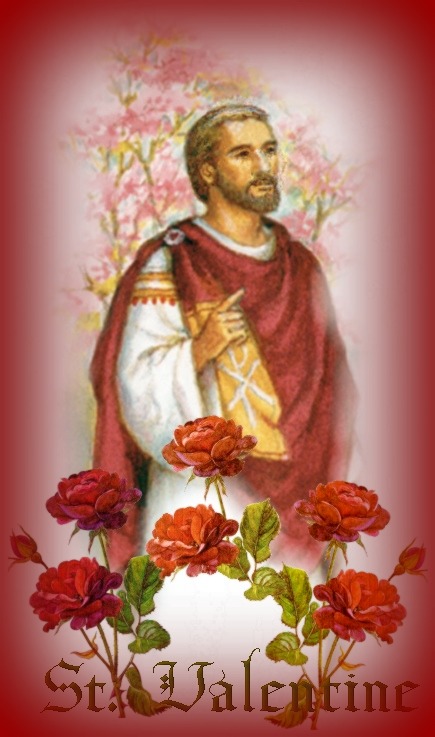
Saint Valentine, priest and martyr, Feb. 14


Saint Valentine, priest and martyr, Feb. 14

From the Book on Ecclesiastical Writers by St. Jerome the Priest

ON this day is commemorated blessed Valentine, a priest of Rome who was martyred for Christ, probably in the persecution of Claudius the Goth, about the year 259. He was buried on the Flaminian Way ; and about 350 a church was built over his tomb, and later a catacomb was constructed there under, wherein were buried the remains of many Martyrs. This church, with its cemetery, was the first to greet the eyes of pilgrims coming to Rome to visit the sepulchres of the ancient heroes of the Faith, and therefore his cultus grew, and spread through the world. But in the early years of the ninth century, his body was transferred to the basilica of St. Praxedes lest, being outside of the walls of the city, it should be desecrated by the Saracens. The popular story is that holy Valentine was cajoled with promises in order to wean him from Christ ; and that when these failed he was beaten with clubs, and finally beheaded. In England, from the time of Chaucer onwards, there was a belief that on his feast-day the birds began to choose their mates. From which arose the custom of arranging betrothals in Saint Valentine's Tide ; and in honour of the fidelity of the servant of God, those who were betrothed called each other Valentine, as a pledge of their mutual fidelity, in token that those who wed are united together in Christ, of whose unbreakable union with humanity in his Church, the Sacrament of Marriage is ever an outward and visible sign.

St. Valentine

Collect:
Grant, we beseech thee, Almighty God : that we who observe the heavenly birthday of blessed Valentine thy Martyr, may by his intercession be delivered from all evils that beset us. Through Jesus Christ thy Son our Lord, Who liveth and reigneth with thee, in the unity of the Holy Ghost, ever one God, world without end. Amen.

Thursday, February 9, 2012

Saint Cyril of Alexandria, Bishop, Confessor & Doctor

St. Hilary of Poitiers

Saint Cyril of Alexandria, Bishop, Confessor & Doctor


A homily by Saint Hilary the Bishop

There is, to my thinking, no such thing as salt of the earth. How then can the Apostles be called the salt of the earth? We must seek out the true meaning of these words, and the same will be made plain when we consider the office of the Apostles, and the nature of salt itself. Now salt is a compound of elements, for it joineth in itself a certain weakness like unto water, and a certain power like unto fire, so that it hath a double nature.

Salt is therefore able to serve the use of men in divers ways, for wherever it is added, it both preserveth from corruption and giveth savour. And to the Apostle was given a similar two-fold power. For the words which they scattered upon the world, as preachers of the kingdom of heaven, do act as a preservative unto immorality ; that is, as preachers they do confer a savour of sweetness, even unto life everlasting, upon those who receive their teaching.

Then the nature of salt is to be ever the same, and unchanging. Man, on the other hand, hath this weakness, to be changeable. He alone is called blessed who hath persevered unto the end and in all the works of God. Therefore doth the Lord warn them whom he calleth the salt of the earth, that they are to remain strong in that strength which he hath given unto them, lest, becoming themselves savourless, they have no power to season anything. Once having lost the freshness of their saltness, they are unable to stop the corruption round about them ; and so the Church must needs cast them out of her buttery. Thus both they and those whom they should have salted, will be altogether trodden under foot of such as enter in.

Hagiography of Cyril


Cyril of Alexandria hath been styled the Doctor of the Incarnation. For he was concerned with the Nestorian heresy from its inception, and denounced the same to Saint Pope Celestine I, and at the Council of Ephesus in 431, at which the heresy was solemnly condemned , he presided as the representative of the Roman See. And the rest of his life was given over the defence of the truth that in Christ Jesus there is one divine Person. * Cyril was born of distinguished parents, and was the nephew of Theophilus, Patriarch of Alexandria, whom he succeeded in that office. He was a man of learning, and of much vigor and determination, and he turned all his powers to the extirpation of heresy and unbelief. His sternness in these matters made him many enemies, even amongst those of orthodox practice, but chiefly he was assailed by the followers of Nestorius, who at one time secured a sentence of excommunication against him as a troublemaker, to which many even of the orthodox bishops assented, which same was later declared null and void. * He wrote much regarding the Faith, and was emphatic in his teaching concerning the Eucharist, whereof he said : We receive it, not as common flesh (which God forbid), nor as the flesh of a man sanctified and associated with the Word, but as indeed the lifegiving and very Flesh of the Word himself. But chiefly he is remembered for his teaching that Mary is the Mother of God, which title the Council of Ephesus acceded to her. At length he died a holy death, in June of the year 444, and the 32nd of his episcopate, but in the west his feast is kept in February.


Collect:

O God, who didst strengthen thy blessed confessor and Bishop Saint Cyril, invincibly to maintain the divine motherhood of the blessed Virgin Mary : vouchsafe that at his intercession we, believing her to be indeed the Mother of God ; may as her children rejoice in her protection, through the same Jesus Christ our Lord. Amen.

Wednesday, January 18, 2012

St. Peter’s Chair at Rome, January 18th


St. Peter’s Chair at Rome, January 18th


From a Sermon by St. Leo the Pope

When the twelve holy Apostles had received from the Holy Ghost the power to speak all languages, they divided the whole world into districts, which they severally allotted to themselves as fields for their Gospel labours. Then was Peter, the Prince of the Apostles, sent to the capital city of the Roman Empire, that he might cause the light to shine thence throughout the whole body of the civilized nations. At that time what race was there that had none of their folk dwelling in Rome? Or, when Rome had learnt, what people that did not learn?

In Rome were many dreams of an unbelieving philosophy awaiting to be destroyed. In Rome were many empty utterances o f earthly wisdom awaiting to be confuted. In Rome was much idolatry awaiting to be overcome. In Rome was great profanities awaiting to be put down. For here in this city the activity of superstition had gathered together from the whole earth every error which it could find. O most blessed Apostle Peter! This was the city to which thou didst not shrink to come. The Apostle Paul, thy comrade in glory, was yet occupied in founding the churches, and thou didst enter alone into that forest of wild beasts roaring furiously ;thou didst commit thyself to that stormy ocean, more boldly that when thou didst walk upon the waters to come to Jesus.

Thou, O Peter, hadst already taught those of the Circumcision who had turned to Christ. Thou hadst founded the Church of Antioch, the first Church that bore the noble name of Christian. Thou hadst published the law of the Gospel throughout Pontus, Galatia, Cappadocia, Asia and Bithynia. And thou didst not fear the hardness of thy work, nor turn back because of thine old age, but didst boldly set up the trophy of the Cross of Christ upon these Roman walls, where the providence of God had appointed the throne of thine honour, and the glorious scene of thy passion.

Collect:

O God, who through the preaching of thy blessed Apostle Saint Paul hast caused the light of the Gospel to shine forth upon the Gentiles : grant, we beseech thee, that we, who this day call him to remembrance, may feel the effectual benefit of his intercession, through Jesus Christ our Lord. Amen.

Saturday, January 14, 2012

Saint Hilary of Poitiers

Saint Hilary of Poitiers, Bishop, Confessor & Doctor

Hilary was born of a most illustrious family in Aquataine, and of him blessed Jerome saith : He was a man of mighty eloquence, the Latin Trumpet against the Arians. He was born of pagan parents , and brought up in idolatry, but in due time was found of Christ and became God’s servant. In early life he had married, but at his ordination he and his wife chose to live in continence. And because of the fame he made for himself by his wisdom and eloquence as a priest, he was chosen to be Bishop of Poitiers, in which office he gained the universal praise of the faithful. At that time the Emperor Constantius was persecuting the Catholics by every species of cruelty, in order to make them yield to the Arian heresy. Against the Arians Hilary set himself up as a brazen wall, and thereby turned upon himself the fierceness of their anger. When they procured his banishment to Phrygia, he used his exile to write a work in twelve books, on the Trinity, against these hereticks. * In the year 359, the fourth of his exile, he was obliged to attend the Council of Selucia in Isauria, which was largely composed of Arians, whom he there publicly withstood. And afterwards he withdrew to Constantinople, where he demanded leave from the Emperor to hold a public disputation in his presence. However, the Arian Bishops Ursacius and Valens, whom Hilary had already confuted in writing, were afraid to meet him in debate, and therefore induced Constantius, under pretence of pardon, to send him back to his bishoprick. And he was followed to Poitiers by Martin, afterwards Bishop of Tours, whose growth in holiness was a fruit of his teaching. * Henceforth he ruled the Church of Poitiers in great peace. His wonderful learning is seen in his numerous written works. And his tenderness of heart is well manifested in a letter, still extant, which during his exile he wrote to his daughter, urging upon her to become a nun, which same by this letter she was moved to do. He passed from earth to heaven upon January 13th, about the 368, during the reign of the Emperors Valentian and Valens. He has been called an Illustrious Doctor of the Church by many Fathers and Councils.


The Collect:
O GOD, who hast enlightened thy Church with the wondrous learning of blessed Hilary thy Confessor and Doctor: mercifully grant to us thy servants; that we, being in all things enlightened by his wisdom, may at all times feel the effectual succour of his righteousness. Through Jesus Christ our Lord. Amen.

Wednesday, December 21, 2011

Saint Thomas the Apostle, Dec 21

Saint Thomas the Apostle, Dec 21


The Apostle Thomas ( whose name signifieth a twin, for which reason in Greek he is called Didymus) was a Galilean. The historian Eusebius saith that after the descent of the Holy Ghost Thomas preached the Gospel to many different peoples, such as the Parthians, Medes, Persians, Hyrcanians, and Bactrians. It is believed that he went last of all to India (for his ministry there is mentioned by holy Ephraem the Syrian, blessed Jerome, and others ) where, because of his holiness and wondrous works, he drew many after him, and brought them to Christ Jesus. For which reason he is said to have provoked the anger of the idolatrous king, who condemned him to be pierced with lances, whereby he crowned the dignity of his apostleship with the glory of martyrdom. Eight miles from Madras, on Big Hill in the Coromandel coast (called in the Martyrology Calamina), is a spot still pointed out as the place of his holy death. His relicks were reputed to have been translated to Edessa, thence to Chios in the Aegean, and later to Ortona in the Abruzzi, where they are to this day venerated with much devotion by the faithful.

A Homily by St. Gregory the Pope

Dearly beloved brethren, what do ye chiefly notice in this passage? Think ye that is was by accident that this chosen Apostle was not with them when Jesus came? Or that when he came, he heard? Or that when he heard, he doubted? Or that when he doubted, he touched? Or that when he touched, he believed? None of these things was accidental, but providential. It was a wonderful provision of divine mercy, that this incredulous disciple, by thrusting his fingers into the bodily wounds of His master, should apply a remedy to the spiritual wounds of unbelief in our souls. The doubts of Thomas have done us more good than the faith of all the disciples that believed. While he feeleth his way to faith by touching, our minds are freed from doubt, and settled in faith.


Antiphon on Magnificat:
O Thomas Didymus to whom it was given to touch the risen Christ, and who now with him art evermore on high, * we entreat thee to pray for us who suffer amidst the evils of this world, lest amongst the lost we receive the sentence of doom, when the Judge appeared.
Collect:
Almighty and everliving God, who for the more confirmation of the Faith didst suffer thy holy Apostle Thomas to be doubtful in thy Son’s resurrection, grant us so perfectly, and without all doubt, to believe in thy Son Jesus Christ; that our faith in thy sight may never be reproved, through the same Jesus Christ our Lord. Amen.
Antiphon on the Benedictus:
Thomas, because thou hast seen me, thou hast believed, * blessed are they that have not seen and yet have believed.

Wednesday, November 30, 2011

Saint Andrew the Apostle, November 30

Saint Andrew the Apostle


Saint Andrew the first called
The Apostle Andrew, who was blood-brother to Peter, was born at Bethsaida, a town of Galilee. He first became a disciple of the Baptist. But when he heard John say : Behold the Lamb of God : he straightway became a disciple of Jesus, to whom he brought his brother Peter also. Some while after, when they went fishing in the Sea of Galilee, the Lord Christ came by and called them both, before any other of the Apostles, in the words : Follow me, and I will make you fishers of men. Whereat without delay they left their nets, and followed him. After the death and resurrection of Christ, according to the ancient historian Eusebius, Andrew was allotted European Scythia as the province of his preaching Other ancient writers say that he went through Epirus and Thrace, and there turned many souls to Christ by his teaching and wondrous works. Finally he is said to have gone to Patras in Achaia, and to have brought many there also to the knowledge of Gospel truth. The particulars of his death were written down by the priests and deacons of Achaia, which same were eye-witnesses of his last sufferings. According to this account, when Aegeas the Proconsul resisted the preaching of the Gospel, the Apostle freely rebuked him, bidding him know that whilst he set himself up as a judge of his fellow men, he was himself in such wise deceived by evil spirits that he was unable to recognize the divine Judge of all men in the person of Christ.
And according to the aforementioned record, blessed Andrew’s martyrdom was on this wise. Aegeas answered the Apostle wrathfully, saying: Boast no more of this matter, for thy Lord Christ spake words even such as thine, but they availed him not, and he was crucified by the Jews. Whereto Andrew boldly answered that Christ of his own will had given himself up to die for man’s salvation. But the Proconsul with blasphemy interrupted him, and bade him look to his own interests ; and if he would save himself, to sacrifice to the gods. Then said Andrew : We have an altar, whereon day by day I offer up to God Almighty, the one and only true God: not the flesh of bulls nor the blood of goats, but a Lamb without spot ; and when all they that believe have eaten of the Flesh thereof, the Lamb that was slain abideth whole and liveth. Then Aegeas, filled with wrath, bound the Apostle in prison. Now the people could easily have accomplished his deliverance, were it not that he himself calmed them, and earnestly besought them not to take from him the crown of martyrdom, for which he longed, and which was drawing near.
And it is said that a short while thereafter, Andrew was brought before the judgement-seat, where he extolled the Mystery of the Cross, and again rebuked Aegeas for his ungodliness. Whereupon Aegeas would bear with him no longer, but commanded him to be crucified, in imitation of Christ. Then was Andrew led to the cross. And when as yet he saw it afar off, he cried out : O gracious cross, made so fair and goodly by the sweet body of my Lord! Long have I desired thee! Constantly have I sought thee! And now that thou art made ready, my soul is drawn to thee! Welcome me from amongst men, and join me anew to my Master, that as by thee in death he redeemed me, so by thee he may take me unto himself once and for all! So he was fastened to the cross, whereon he hung living for two whole days, during which time he ceased not to preach the Faith of Christ, and finally, passed into the presence of him the likeness of whose death he had loved so well. Under the Emperor Constantine the relicks of the Apostle were first taken to Constantinople, whence they were afterwards brought to Amalfi. But in the pontificate of Pope Pius II his head was carried to Rome, where it is kept in the Basilica of Saint Peter, that the relicks of these two blood-brothers might be nigh each other. Blessed Andrew is revered as the Patron of Scotland and Russia, and his name is twice read in the Gregorian Canon ; namely, first in the Canon proper, and secondly in the Embolism.
 
Antiphon of the Magnificat:
One of the two which followed the Lord was Andrew, * Simon Peter’s brother, Alleluia.
Collect:
Almighty God, who didst give such grace unto thy holy Apostle Saint Andrew, that he readily obeyed the calling of thy Son Jesus Christ, and followed him without delay : grant unto us all , that we, being called by thy holy Word, may forthwith give up ourselves obediently to fulfil thy holy commandments, through the same Jesus Christ our Lord. Amen.
Antiphon on the Benedictus:
And the bystanders pleaded for him: Spare this innocent man! Restore to us this holy one! Slay not him that is so dear to God! * for he is just and meek and godly.

A Homily by Saint Gregory the Pope

Dearly beloved, ye have heard how Peter and Andrew, at one word of command, left their nets, and followed their Saviour. As yet they had seen none of his miracles. As yet they had received no promise of their eternal and exceeding great reward. Nevertheless, at one word from the Lord they forgat all those things which they seemed to have. We on the contrary have seen many of his miracles. We have received many of his gracious chastenings. Many times hath he warned us of the wrath to come. How is it then that when the Lord calleth we do not follow?
Christ who calleth us to be converted is now enthroned in heaven. He hath bowed the necks of the Gentiles under the yoke of the Faith. He hath laid low the glory of the world, and the ruins thereof on all sides do preach unto us that day when he is to be revealed as our Judge is drawing nigh. Yet so stubborn is our mind that we will not freely abandon what willy nilly we are each day losing. Dearly beloved, what shall we answer at his judgement-seat, we whom no lessons can persuade and no stripes can break from the love of this present world?
Some one perchance will ask in his heart, what these two fishermen had to lose by obeying the call of the Lord? Dearly beloved, we must consider here the intention, rather than the loss incurred by this obedience. He that keepeth nothing for himself giveth up much. He that sacrificeth his all, sacrificeth what is to him a great deal. Beyond doubt, we cling to whatever we have, and what we have least, that we desire most. Peter and Andrew therefore gave up much when they gave up even the desire of possessing anything.

Friday, November 25, 2011

Saint Catherine of Alexandria, Virgin and Martyr

Saint Catherine of Alexandria, Virgin and Martyr


Catherine of Alexandria, since the tenth century, hath been held in great veneration, and that more in the West than in the East. She is esteemed as the Patroness of learned folk and of wheel-wrights and millers, and the Dominicans have adopted her as one of their Patrons. Her fame is as follows. She was a noble maiden of Alexandria who became, through her studies, a very learned woman, and prevailed over the chief wits of the day. * And she went boldly to Maxentius, and rebuked him for his savage cruelty toward Christians, bringing forward likewise most sage reasons why the Faith of Christ should be needful for salvation. Maxentius marveled at her wisdom, and detained her, whilst he gathered together the most learned men from all quarters, and offered them great rewards if they could confute Catherine, and bring her to worship idols. But the event fell contrariwise, for many of the philosophers who had come to dispute with her were overcome by the force and skill of her reasoning, so that the love of Christ Jesus was kindled in them, and they were content even to die for his sake. Then did Maxentius strive to beguile Catherine with fair words and promises, and when he found it was lost pains, he caused her to be cast into prison and starved. * Afterwards Catherine was brought out of the ward, and a wheel was set, wherein were fastened many and sharp blades, so that her virgin body might be most direfully cut and torn in pieces. But when it was set in motion it flew to pieces, which so enraged Maxentius that he forthwith commanded to behead Catherine. So, on November 25, about the year 310, she attained the twin crowns of martyrdom and virginity. It is said that her body was carried by Angels to Mount Sinai, and there enshrined, in the famous monastery called by her name. And this by some writers is interpreted to mean that it was carried thither by the monks of Sinai, to be their great treasure, for of old times the monastic habit was known as the angelical habit, and those that wore the same were sometimes given the honorific title of Angel, to signify that state of heavenly worship wherein they should live.


Collect:
O God, who on Mount Sinai didst give the law to Moses, and afterwards, through the ministry of holy Angels, didst mystically give rest thereon to the body of blessed Catherine thy Virgin and Martyr : grant, we beseech thee, that by her intercession, we may be brought unto that mountain which is Christ, by the same thy Son our Lord, who liveth and reigneth with thee and the Holy Ghost, one God, world without end. Amen.

Thursday, July 7, 2011

The Antiochian WRV Parochial Divine Office yields timely message,

While praying the Office this morning, the appointed psalms seemed very apt in contrast to all the vengeful venting online and in public regarding the Casey Anthony verdict. Many people are quite exercised that she was not found guilty of murder and sentenced to death, or at least life without parole.

"...but grieve not thyself at him whose way doth prosper, against the man that doeth after evil counsels. Leave off from wrath, and let go displeasure: * fret not thyself, else shalt thou be moved to do evil. Wicked doers shall be rooted out; * and they that patiently abide the LORD, those shall inherit the land. Yet a little while, and the ungodly shall be clean gone: * thou shalt look after his place, and he shall be away." psalm 37


One point lost on many is that in our system of jurisprudence, if the state cannot prove beyond a reasonable doubt that the accused did the deed, the jury is required to exonorate. This high standard is so important for the liberty of all the citizens of our Republic, and that is the way we want it, lest the government be empowered to do away with its opponents by juridical chicanery.

While she may indeed be guilty, she will face divine justice. That's an awful lot fierier than the human variety.

Wednesday, March 9, 2011

Ash Wednesday Matins Lessons


The First Lesson

Isaiah 58:1-12

Cry aloud, spare not, lift up thy voice like a trumpet, and shew my people their transgression, and the house of Jacob their sins. Yet they seek me daily, and delight to know my ways, as a nation that did righteousness, and forsook not the ordinance of their God: they ask of me the ordinances of justice; they take delight in approaching to God. Wherefore have we fasted, say they, and thou seest not? wherefore have we afflicted our soul, and thou takest no knowledge? Behold, in the day of your fast ye find pleasure, and exact all your labours. Behold, ye fast for strife and debate, and to smite with the fist of wickedness: ye shall not fast as ye do this day, to make your voice to be heard on high. Is it such a fast that I have chosen? a day for a man to afflict his soul? is it to bow down his head as a bulrush, and to spread sackcloth and ashes under him? wilt thou call this a fast, and an acceptable day to the Lord? Is not this the fast that I have chosen? to loose the bands of wickedness, to undo the heavy burdens, and to let the oppressed go free, and that ye break every yoke? Is it not to deal thy bread to the hungry, and that thou bring the poor that are cast out to thy house? when thou seest the naked, that thou cover him; and that thou hide not thyself from thine own flesh? Then shall thy light break forth as the morning, and thine health shall spring forth speedily: and thy righteousness shall go before thee; the glory of the Lord shall be thy rereward. Then shalt thou call, and the Lord shall answer; thou shalt cry, and he shall say, Here I am. If thou take away from the midst of thee the yoke, the putting forth of the finger, and speaking vanity; And if thou draw out thy soul to the hungry, and satisfy the afflicted soul; then shall thy light rise in obscurity, and thy darkness be as the noon day: And the Lord shall guide thee continually, and satisfy thy soul in drought, and make fat thy bones: and thou shalt be like a watered garden, and like a spring of water, whose waters fail not. And they that shall be of thee shall build the old waste places: thou shalt raise up the foundations of many generations; and thou shalt be called, The repairer of the breach, The restorer of paths to dwell in.


The Second Lesson

Hebrews 12:1-14

Wherefore seeing we also are compassed about with so great a cloud of witnesses, let us lay aside every weight, and the sin which doth so easily beset us, and let us run with patience the race that is set before us, Looking unto Jesus the author and finisher of our faith; who for the joy that was set before him endured the cross, despising the shame, and is set down at the right hand of the throne of God. For consider him that endured such contradiction of sinners against himself, lest ye be wearied and faint in your minds. Ye have not yet resisted unto blood, striving against sin. And ye have forgotten the exhortation which speaketh unto you as unto children, My son, despise not thou the chastening of the Lord, nor faint when thou art rebuked of him: For whom the Lord loveth he chasteneth, and scourgeth every son whom he receiveth. If ye endure chastening, God dealeth with you as with sons; for what son is he whom the father chasteneth not? But if ye be without chastisement, whereof all are partakers, then are ye bastards, and not sons. Furthermore we have had fathers of our flesh which corrected us, and we gave them reverence: shall we not much rather be in subjection unto the Father of spirits, and live? For they verily for a few days chastened us after their own pleasure; but he for our profit, that we might be partakers of his holiness. Now no chastening for the present seemeth to be joyous, but grievous: nevertheless afterward it yieldeth the peaceable fruit of righteousness unto them which are exercised thereby. Wherefore lift up the hands which hang down, and the feeble knees; And make straight paths for your feet, lest that which is lame be turned out of the way; but let it rather be healed. Follow peace with all men, and holiness, without which no man shall see the Lord:


The Collect

Ash Wednesday

ALMIGHTY and everlasting God, who hatest nothing that thou hast made, and dost forgive the sins of all those who are penitent; Create and make in us new and contrite hearts, that we, worthily lamenting our sins and acknowledging our wretchedness, may obtain of thee, the God of all mercy, perfect remission and forgiveness; through Jesus Christ our Lord. Amen.

Saturday, February 26, 2011

Saint Ethelbert, King & Confessor, Feb. 26

Saint Ethelbert, King & Confessor
 
Ethelbert, who was born a pagan but whose wife Bertha was a Christian, was King of Kent and the regions round about. At the time that Saint Pope Gregory sent Saint Augustine to evangelize the English, Ethelbert received these missionaries with kindness, and in reward God gave him the grace of faith, whereat he was baptized on Pentecost in 597. Thenceforward he was changed into another man, and did much toward the spread of Christianity and the building of Churches and monasteries. Further, he was a lawgiver, and his, so for as is known, were the first written laws of England. In 616 he went to his great reward with God.

Click here to read more...

O God, who didst bestow upon blessed King Ethelbert thy Confessor the crown of everlasting glory : grant us, we beseech thee, that we may in such wise honour him in this our life on earth, that we may be found worthy to reign with him in heaven, through Jesus Christ our Lord. Amen.

Collect:

Friday, February 4, 2011

Kontakion to the New Martyrs of Russia


The Neo-Martyrs of Russia
1917AD & following
February 4
Collect:
O God of unspeakable mercy, who didst enable thy holy Russian Martyrs to
overcome their enemies by dying for Thy name: deliver us, we beseech thee, at their
intercession from slavery to sin: that with them we may come to thy perfect freedom in
the heavenly fatherland. Through
 

Saturday, January 15, 2011

Saint Paul the First Hermit, Confessor

January 15, Saint Paul the First Hermit, Confessor
   

According to an ancient book, edited by Saint Jerome, the life of this Paul, the first Hermit, and the model of all others, was on this wise. He was a native of the Lower Thebaid in Egypt. At the age of fifteen he lost both his parents, and to serve God in quietness, betook himself to a cave in the desert, where was a palm 
St.Paul the Hermit
tree, on the fruit of which he lived, and of whose leaves he made his raiment until he attained the age of 113 years. At that time Anthony, being himself ages ninety years, received a command from God to go and see him. And thus they met without knowing one another’s names ; but after mutual salutations, they fell straightway into a long discourse concerning the kingdom of God. Now it so happened that a raven had for sixty years brought Paul every day half a loaf, but on this day while they spake together he brought a whole one. * When the raven had flown away, they asked a blessing, and ate together, sitting by a spring. When they were refreshed, they returned thanks, and afterwards spent the whole night praising God. At the break of day Paul felt the approach of death, and desired Anthony to go and fetch, for his winding-sheet, a cloak which Athanasius had given to this same Anthony. On his way back from his journey, Anthony saw in a vision the soul of Paul ascending to heaven, surrounded by choirs o9f Angels, and accompanied the Prophets and Apostles. * when Anthony reached the cell of Paul, he found there the dead body of the Saint, which he wrapped in the cloak of Athanasius ; and then he immediately began to chant the Psalms and hymns ordained by Christian tradition. Whereafter, having no spade to dig a grave, two lions came racing from the desert as though to attend the burying, and scratched a hole big enough to hold a man’s body, shewing meanwhile such signs of grief as their nature alloweth. When they were gone away, Anthony put the holy body in this hole, covered it with earth, and arranged it like a Christian’s grave. But he took away for himself Paul’s tunic, which he had woven out of the palm-leaves somewhat after the manner of basket-work, and this tunic Anthony was in the habit of wearing the great days of the Passion and Pentecost as long as he lived. The date of holy Paul’s death is set at the year 342.


O God, who makest us glad with the yearly feast of thy Confessor Saint Paul the Hermit, mercifully grant that as we now observe his heavenly birthday, so we may follow him in all virtuous and godly living, through Jesus Christ our Lord. Amen.
Collect:

Saint Maurus, Abbot, Disciple of St. Benedict

January 15, Saint Maurus, Abbot, Disciple of St. Benedict.
St.Maurus rescues St.Placidus
 
This Maurus was born of a noble Roman family, and as a child was offered to god by his father Equitius, to be under the personal teaching of Saint Benedict. And that in a short while the youth made such progress that he became a wonder to his master, who often held him up to his other disciples as a pattern of regular observance and all virtues. Pope Saint Gregory the Great, who hath preserved for us in his writings much sacred history, hath recorded, as a wonderful instance of his obedience, this following tale. Placidus the monk fell into a lake, and as he was being swept away by the current, the holy Patriarch called Maurus and bade him run to the rescue ; which same he did, walking on the water till he reached Placidus, whom he took by the hair of the head, and dragged to the shore. Holy Maurus was sent by Saint Benedict into France ; and that he there founded the celebrated monastery which bore his name ; and that he governed the same for many years ; and that he from thence passed to heaven, famous for holiness and miracles, when he was more than seventy years of age, which would be about the year 584.

Collect:
Grant, we beseech thee, O Lord, that the prayers of thy holy Abbot, blessed Maurus may commend us unto thee, that we, who have no power of ourselves to help ourselves, may by his advocacy find favour in thy sight, through Jesus Christ our Lord. Amen.

Thursday, January 13, 2011

Octave Day of the Epiphany, January 13

The Octave Day of the Epiphany , January 13th

 From a Sermon by Saint Gregory Nazianzus
 
I cannot restrain the outburst of my happiness on this occasion. Yes, I am uplifted in mind, and my heart is deeply moved. And thereby I am in danger of forgetting mine own meanness, in my longing for the office of the great John Baptist. Or rather, I should say, I am filled with desire to undertake the service which he performed. It is true that I am not, as was he, Christ’s Forerunner ; but at least I come, as did he, from the desert. And like him, my joy is in Christ who was, as on this day, illuminated ; or I might better say, My joy is in Christ who now doth immediate us, and that with his own splendour. For Christ is baptized!
Therefore, let us go down together with him into the deep, that likewise together with him we may go up, enlightened with his splendour.
John is baptizing ; Jesus draweth nigh. And he is come thither that perchance he may sanctify the one that now acteth as the ministrant of Baptism; and that he may beyond all doubt bury the Old Adam beneath the flood ; and that he may hallow the baptismal streams, such as of Jordan, above all other water. For he who is both Spirit and Flesh would open, to all that should ever be baptized, the power of grace, whereby we may be born again, of the water and the Spirit. But lo! The Baptist putteth him off ; nevertheless Jesus insisteth. I, saith John, have need to be baptized of thee! So speaketh the Candle to the Sun ; so saith the Voice to the Word.
Jesus cometh up from the waters! In the Second Adam all mankind hath been washed. The whole world, which had been submerged, is uplifted. And thereupon the heavens were opened unto him. Not cleft merely, but set open wide! For those same heavens were, by the sin of the First Adam, closed to himself, and to us his posterity, what time the flaming swords of the Cherubim barred the gates of paradise. But the heavens were opened wide to the Second Adam. And then did the Holy Ghost himself bear witness. The Spirit beareth witness to one who is of the same substance as himself. For witness fitly cometh down from heaven unto one who is from thence.

Wednesday, January 12, 2011

Benedict Biscop, Abbot, January 12.

Saint Benedict Biscop, Abbot, January 12


The surname of this Benedict was Biscop. He was born in the year 628, of the highest Saxon nobility, and was ever very dear to the devout King Oswy of the Northumbrians, whose thane he was. At the age of twenty-five he restored his estates to the King, and put away all thought of marriage and of advancement in this world, and rather gave himself over to the things of God ; who made use of him in the establishment of learning and ecclesiastical decencies throughout England during the times when Saints Theodore and Hadrian were labouring to these ends. His first thought was to visit the shrines of the blessed Apostles at Rome, and gain there in the Christian capital of the world a wider learning than could be got in any other place. After his return home he did much to spread this learning in England. He returned to Rome again in the time of Saint Pope Vitalian ; but shortly after he went to the monastic Island of Lerins, where Saint Vincent had lived and taught, and there he took the monastic habit and vows.* After two years he returned to Rome, at the time when Saint Theodore, the Greek monk, was about to be sent as Archbishop to Canterbury. And Saint Vitalian, knowing his worth, ordained him, and sent him along with holy Theodore. When they came to Canterbury, Benedict was made Abbot of the Monastery of Saints Peter and Paul in that city, until Saint Hadrian was able to come from Rome to England and assume the government thereof. Whereupon Benedict undertook still another journey to Rome, and brought back a great library of books to England, some of which he had begged and others which he had bought. Then he betook himself to King Egfrid of the Northumbrians, the son of his former master and friend. The same made him an ample gift of ground at Wearmouth, for a monastery. After the founding of which, Benedict obtained masons from Gaul, to build him a stone church, and glaziers to glaze the windows ; for hitherto in England stone buildings were rare and glass-making unknown. After this he took for the fifth time the long and perilous journey to Rome ; and necessaries which he could not obtain in Gaul he brought back with. * In particular he brought back John, the Precentor of Saint Peter’s Church in Rome, to teach in England the true ecclesiastical chant and the principals liturgical prayer. After his return from this journey Benedict, by another benefaction of the same King Egfrid, founded another monastery, namely, at Jarrow upon the Tyne. When this foundation was secure, he went forth for the sixth time on a mission to Rome. But on his return therefrom he found that a pestilence had carried away many of his friends, and in the monastery of Jarrow no one was left but the Abbot, and a lad named Bede who lived to become known as The Venerable, Benedict soon afterwards lost his health and suffered for three years. During which he oftentimes impressed upon the brethren the necessity of keeping the rule, and of preserving the excellent and abundant library which he had brought together as a needful equipment for sacred learning. He fell asleep in the Lord upon January 12th, 690, and was buried in the monastery at Wearmouth.
 
Collect:
O God, who to the blessed Abbot Benedict Biscop, gavest grace to imitate Christ in his poverty, and with humble heart to follow him to the end : grant that all who enter the path of Gospel may neither look back nor go astray from the way, but hastening to thee without stumbling, may attain the crown of eternal life whereunto thou dost call them, through the same Jesus Christ our Lord. Amen.
 

Wednesday, January 5, 2011

The Epiphany, or Manifestation of Christ.

The Manifestation of Christ to the Gentiles, January 6

Adoration of the Magi
From a Sermon by St. Leo the Pope
 
Dearly beloved, rejoice in the Lord ; and again I say, rejoice. Only a few days are past since the Solemnity of Christ’s Nativity, and now the glorious light of Epiphany is breaking upon us. On that day the Virgin brought him forth, and on this he was made known to the world. For the Word-made-Flesh was pleased to reveal himself by degrees to those unto whom he had come. When Jesus was born he was first manifested to the believing, but hidden from his enemies. However, the heavens declared the glory of God and their sound went out into all lands, namely, when the herald-Angels appeared to tell the shepherds the glad tidings of a Saviour’s birth. And now the guiding star leadeth the Wise Men to worship him, that from the rising of the sun, even unto the going down thereof, the birth of the true King may be known abroad ; that through those Wise Men the kingdoms of the East might learn the great truth, and the Roman empire remain no more in darkness.

The very cruelty of Herod, when he strove to put an end to the new-born King whom he feared, was made an unwitting means to further this new dispensation of mercy. For the tyrant was so intent on his horrid crime of slaying the little Child, that he did not perceive how his indiscriminate slaughter of the Innocents would serve to spread wider abroad the story of a new-born Babe whose birth as a great ruler had been announced from heaven. Thus were these glad tidings loudly proclaimed, both by the novelty of their story, and the iniquity of their enemies. Moreover, the Saviour was carried into Egypt. And thereby that nation, so long hardened in idolatry, was (by the mysterious virtue which went forth from Christ, even when his presence was unknown,) prepared for the saving light so soon to dawn on them ; if so be, they might receive the Truth as a wanderer even before they had banished falsehood.

Dearly beloved, we recognize in these Wise Men, who came to worship Christ, the first-fruits of that dispensation to the Gentiles wherein we also are called and enlightened. Let us then keep this Feast with grateful hearts, in thanksgiving for our blessed hope, the dawn of which we do commemorate on this day. From the worship paid to the new-born Christ is to be dated the entry of us Gentiles upon our heirship of God and joint-heirship with Christ. Since that joyful day the Scriptures which testify of Christ have lain open for us as well as for the Jews. Whose blindness rejected that Truth which, since that day, hath shed his bright beams upon all nations. Let us then honour this most sacred day, whereon the Author of our salvation was made manifest. As the Wise Men fell down and worshipped him in the manger, so let us fall down and worship him, enthroned omnipotent in heaven. As they opened their treasures and presented unto him mystic and symbolic gifts, so let us strive to open our hearts to him, and offer him from thence some worthy offering.

Antiphon on the Magnificat:
The Wise Men,† beholding the star, said one to another : This is the sign of a mighty King ; forth fare we to seek him: * and let us offer him gifts, gold and incense and myrrh, alleluia.
 
Collect:
O God, whose only-begotten Son hath been manifest in the substance of our flesh : grant, we beseech thee, that, like as we have known him after the fashion of our outward likeness, so we may inwardly be made regenerate in him, through the same thy Son Jesus Christ our Lord, who liveth and reigneth with thee, now and forever. Amen.
Antiphon on the Benedictus:
As on this day † is the Church espoused to her heavenly Bridegroom, forasmuch as in Jordan Christ hath cleansed her iniquities: * therefore do the Wise Men hasten with their offerings to the royal nuptials where the guests are regaled with water made wine, alleluia.

Tuesday, January 4, 2011

Saint Titus of Crete, Bishop and Confessor, Jan. 4

St. Titus, Bishop and Confessor, January 4
 
Titus was a gentile who became the disciple of the Apostle Paul, and was twice sent on missions to the Church in Corinth. Concerning this holy man, the Apostle wrote to the Corinthians : When I came to Troas to preach Christ’s Gospel, and a door was opened unto me of the Lord, I had no rest in my spirit, because I found not Titus my brother ; but taking my leave of them, I went from thence into Macedonia. Again, he wrote : When we were come into Macedonia, we were troubled on every side ; nevertheless God, that comforted those that are cast down, comforted us by the coming of Titus. * Paul, because of his regard for Titus, sent him to Corinth on a mission mainly concerned with the collection of alms from the charity of the faithful for the relief of the poor Hebrew Christians at Jerusalem. This mission Titus discharged with such wisdom and gentleness, that he not only strengthened the Corinthians in the Faith, but also stirred up in them an earnest desire, a mourning, a fervent mind toward Paul the earliest teacher. Many were the other journeys by land and sea which Titus undertook. Filled with boldness and zeal, he went with Paul to the island of Crete. Of this Church of Crete the Apostle himself made him the first Bishop ; and we may not doubt that, as such, he was what Paul bade him be : IN all things a pattern of good works, in doctrine, in uncorruptness, in gravity. * He is said to have sweated mightily to unfurl the banner of the Cross among the Dalmatians. And it is believed that, full of days and good works, upon a 4th of January, in the ninety-fourth year of his age, he died one of those deaths which are precious in the sight of the Lord; and that he was buried by the Church of which the Apostle had made him the minister. His praises have been mostly written by Saint John Chrysostom and Saint Jerome.

Antiphon on the Magnificat:
O holy Priest and Bishop,† thou worker of so many mighty works, and good shepherd to Christ’s flock, * pray for us unto the Lord our God (alleluia).
 
Collect:
O God, who on thy blessed Confessor Saint Titus didst bestow the virtues of thine Apostles: grant, we beseech thee, that by his merits and intercession ; we may so live righteously and soberly in this world, that we may be found worthy to attain unto our country in heaven, through Jesus Christ our Lord. Amen.
Antiphon on the Benedictus:
Well done,† good and faithful servant : thou hast been faithful over a few things, * I will make thee ruler over many things, saith the Lord (alleluia).

Octave Day of the Holy Innocents

Octave Day of the Holy Innocents

Matins Lesson 1 & 2.


 Romans 7

1Know ye not, brethren, (for I speak to them that know the law,) how that the law hath dominion over a man as long as he liveth?
2For the woman which hath an husband is bound by the law to her husband so long as he liveth; but if the husband be dead, she is loosed from the law of her husband.
3So then if, while her husband liveth, she be married to another man, she shall be called an adulteress: but if her husband be dead, she is free from that law; so that she is no adulteress, though she be married to another man.
4Wherefore, my brethren, ye also are become dead to the law by the body of Christ; that ye should be married to another, even to him who is raised from the dead, that we should bring forth fruit unto God.
5For when we were in the flesh, the motions of sins, which were by the law, did work in our members to bring forth fruit unto death.
6But now we are delivered from the law, that being dead wherein we were held; that we should serve in newness of spirit, and not in the oldness of the letter.
7What shall we say then? Is the law sin? God forbid. Nay, I had not known sin, but by the law: for I had not known lust, except the law had said, Thou shalt not covet.
8But sin, taking occasion by the commandment, wrought in me all manner of concupiscence. For without the law sin was dead.
9For I was alive without the law once: but when the commandment came, sin revived, and I died.
 
 
Matins Lesson 3.
From a Sermon by St. Augustine the Bishop
Once the Lord was born, mourning beginneth ; not indeed in heaven, but on earth : lamentation amongst mothers; joy amongst angels; migration amongst infants. It is God who is born. For him, Innocents be a fit sacrifice, in that he cometh to condemn the wickedness of the world. Fitly are little lambs offered, in that there shall one day be crucified the Lamb that taketh away the sins of the world. But the ewes do complain at the loss of their lambs, dumbly bleating, unable to speak. O mighty martyrdom! O cruel sight! The sword is drawn, yet there is no cause for the same. It is envy alone that demanded this blood, seeing that he who is born doth violence to no one. Nonetheless we do see mothers, like ewes, mourning over their lambs. In Rama was there a voice heard, lamentation, weeping, and great mourning. But these lambs be pledges, not entrusted to man, rather created only for God; not come to remain in the sight of mankind, but only to be shewn forth for a brief space in their sight.
Collect:
O God, whose praise the martyred Innocents did this day proclaim, not by speaking but by dying, do to death in us all the malice of sinfulness, that our lives may also proclaim thy faith, which our tongues profess, Through Jesus Christ thy Son our Lord, who liveth and reigneth with thee and the Holy Ghost, one God, forever and ever. Amen.

Saturday, January 1, 2011

The Circumcision of Our Lord Jesus Christ


The Circumcision of Our Lord Jesus Christ


A Homily by St. Ambrose the Bishop
 
And when eight days were accomplished for the circumcising of the Child, hi Name was called JESUS : This is the Child of whom it is said ; Unto us a Child is born, unto us a Son is given : or again : Made under the Law to redeem them that were under the Law : or again : To present him to the Lord. (In my Commentary on Isaiah I have already explained what is meant by being presented to the Lord in Jerusalem, and therefore I will not enter into the subject again.) He that is circumcised in heart gaineth the protection of God, as it is written : The eyes of the Lord are over the righteous. Ye will see that as all the ceremonies of the Old Law were types of realities in the New Law, so the circumcision of the body signified the cleansing of the heart from the guilt of sin.

But since the body and mind of man remain yet infected with a proneness to sin, the circumcision of the eighth day is meant to put us in mind of that complete cleansing from sin which we shall have at the resurrection. This is doubtless to be inferred from the words: Every male that openeth the womb shall be called holy unto the Lord. That is, these words are literally true only of the delivery of the Blessed Virgin. Verily, he that opened her womb was holy, for he was altogether without spot. And we may gather that the Law hath this meaning because the Angel said almost the same words : That Holy Thing which shall be born of thee shall be called the Son of God.

Among all them that are born of women the Lord Jesus Christ steed alone in holiness. He alone, because of his immaculate birth, felt no contagion from human corruption ; it came not near him because of his heavenly majesty. Otherwise ( that is, if we are to apply this passage of the Law literally ) we are obliged to say that without exception every male that openeth the womb is holy ; and how then shall we explain that so many were unrighteous? Was Ahab holy? Were thay holy on whom Elijah justly called down fire from heaven? But he to whom the sacred commandment of the Law of Ho9d is mystically directed is the Holy One of Israel. And he alone hath opened the secret womb of his holy virgin - bride the Church, filling her with a sinless fruitfulness whereby to bring forth the People of God.
 
Antiphon on the Magnificat:
God, for his great love… wherewith he loved us, * hath sent his own Son in the likeness of sinful flesh, alleluia.


Collect:
Almighty God, who madest thy blessed Son to be circumcised, and obedient to the law for man; Grant us the true circumcision of the Spirit; that, our hearts, and all our members, being mortified from all worldly and carnal lusts, we may in all things obey thy blessed will; through the same thy Son Jesus Christ our Lord. Amen.

 
Antiphon on the Benedictus:
A great and wondrous mystery… is made known to us this day : in a new manner are natures united, for God is become incarnate * what he was, he still abode ; and what he was not, he took unto himself, suffering in his Person neither confusion nor division.