My life and sojourn to the Holy Orthodox Faith, in Christ's One Holy Orthodox Church, in the Western Rite tradition of the Holy Orthodoxy, the Church founded by Jesus Christ!
Welcome!
Thanks for visiting my blog! I hope it will serve to inspire you and perhaps inform you in some small way regarding the Holy Orthodox Faith or our Lord Jesus Christ. Feel free to comment or ask questions. Christ be with you!
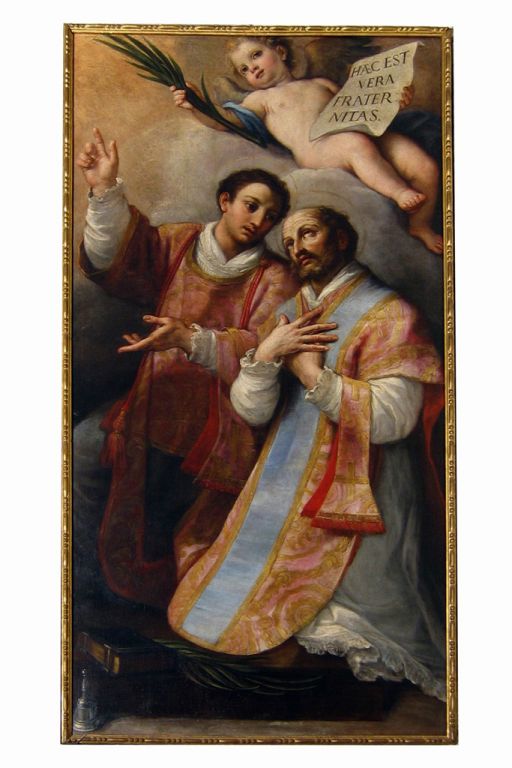
Faustinus and Jovita were brothers, nobly born, and were zealous professors of the Christian religion, which they preached without fear in their city of Brescia in Lombardy, during the persecution of Adrian. Their remarkable zeal excited the fury of the heathens against them, and procured them a glorious death for their faith.
Faustinus, a priest, and Jovita, a deacon, were preaching the Gospel fearlessly in the region when Julian, a pagan officer, apprehended them. They were commanded to adore the sun, but replied that they adored the living God who created the sun to give light to the world. The statue before which they were standing was brilliant and surrounded with golden rays. Saint Jovita, looking at it, cried out: “Yes, we adore the God reigning in heaven, who created the sun. And you, vain statue, turn black, to the shame of those who adore you!” At his word, it turned black. The Emperor commanded that it be cleaned, but the pagan priests had hardly begun to touch it when it fell into ashes.
The two brothers were sent to the amphitheater to be devoured by lions, but four of those came out and lay down at their feet. They were left without food in a dark jail cell, but Angels brought them strength and joy for new combats. The flames of a huge fire respected them, and a large number of spectators were converted at the sight. Finally sentenced to decapitation, they knelt down and received the death blow. The city of Brescia honors them as its chief patrons and possesses their relics, and a very ancient church in that city bears their names.
Collect:
O God, which makest us glad with the yearly festival of blessed Faustinus and Jovita, thy holy martyrs, grant, we beseech thee, that as we do rejoice in their merits, so we may be enkindled to follow them in all virtuous and godly living, through Jesus Christ our Lord. Amen.
Agatha was early recognized by the Church as one of the most illustrious of virgin Martyrs. Therefore, along with Lucy, Agnes, and Cecilia, her name is mentioned in the Gregorian Canon. She was martyred in about 251, in Sicily and soon filled Christendom with her praises. According to her Acts, (which were compiled long after her death), the Praetor of Sicily, Quintianus, conceived a passion for Agatha, who was of noble birth and of great beauty. And when he could not make her consent to his wicked desires, he had her arrested as a Christian, and turned her over to an evil woman, named Aphrodisia, to be corrupted. Of such methods for breaking down Christian hardihood, Tertullian wrote to the pagans : Ye, by condemning the Christian maid to the lewd youth, rather than to the brute lion, do acknowledge that we more dread a stain to purity than any torment or death ; but your cruel cunning availed only to gain men over to our holy religion.
But the companionship of Aphrodisia in the brothel made Agatha only the more determined to live faithful to Christ. Whereat the Praetor ordered her brought before him, that he might try to turn her from Christian living, which he declared to be fit only for slaves. Then the Praetor gave her the choice of sacrificing to the gods or undergoing torture. And when beatings, the rack, and branding with white-hot metal failed to shake her constancy to Christ, he ordered her breasts cut off. Whereat Agatha cried, and said that he who had suckled at a mother’s breasts should feel shame to order such cruel indignity done to a woman. But that night, after she had been returned in irons and pain to prison, the Apostle Peter appeared to her, and healed her wounds.
The following day she was subjected to new tortures. But an earthquake, from Mount Aetna, shook the town and terrified the people. Whereupon the Praetor, fearing a riot, ordered Agatha to be returned quietly to prison. And there, in the town of Catania, she died at peace, in prayer, on February 5th, and her body was taken and buried by the Christians. She is invoked against earthquake and fire and molten lava, and is accounted patroness of bell-founders.
Collect:
O God, who among the manifold works of thine almighty power hast bestowed even upon the weakness of women the strength to win the victory of martyrdom : grant, we beseech thee ; that we, who on this day recall the heavenly birth of Saint Agatha thy Virgin and Martyr, may so follow in her footsteps, that we may likewise attain unto thee, through Jesus Christ thy Son our Lord, who liveth and reigneth with thee, and the Holy Ghost, ever one God, world without end. Amen.
Saints Vincent and Anastatius, Martyrs, January 22nd
Vincent was a deacon of Saragossa in Spain, who suffered great tortures and death in the year 304 at Valencia, supposedly on January 22nd. At a very early date his fame spread abroad through Christendom, and he hath ever since been honored as one of the noblest of the early Martyrs. The Acts of blessed Vincent were already extant by the time of Saint Augustine, who said in a sermon on this Martyr that they lay before him as he preached ; and the poet Prudentius wrote of him. From such written Acts and poetry his history took its present form, which is one of the treasures of Christian culture. * The history of St. Vincent runs thus. The Bishop of Saragossa had an impediment in his speech, for which reason the Deacon Vincent did the preaching. And in the persecution of Dacian, Vincent spake for the Bishop and his followers at the judgement seat, whereat he was scourged, tormented on the rack, blistered on a grating over burning coals, torn with iron hooks, and his wounds cauterized with hot metal. He was then laid on potsherds, lest he should sleep from exhaustion. But as he lay in his dark cell, it was suddenly filled with glorious light. Then Dacian tried to seduce him from Christ by pretended kindness, and had him laid in a soft bed. But Vincent, who had suffered beyond human endurance, thereupon passed at once to his Master whom he had loved so bravely. Whereat his body was thrown out unburied. But a raven came and guarded it, and by beak, claws, and wings kept off other birds, and even a wolf. Dacian then had the body thrown into the sea, which washed it up again. Then it was reverently buried by the Christians. His relicks are still venerated at Saragossa. * Anastasius was martyred on January 22nd, in 628. The holy Cross carried away in Persia by Chosroes had this Anastasius as one of its trophies. He was a Persian, the son of a Magian and a soldier in the Persia army, who was made inquisitive regarding Christ by the controversies over the Cross, and so went to Jerusalem and learned Christ and became a monk. He was tortured at Caesarea, and then brought to Chosroes who was in Assyria, by whose orders he was strangled, then beheaded. His relicks were later taken to Rome, and laid in the Monastery of Saints Vincent and Anastasius.
Collect:
Assist us mercifully, O Lord, in these our supplications, that whereas we are tied and bound by the chain of our sins, the intercession of thy blessed Martyrs Vincent and Anastatius may speedily help and deliver us, through Jesus Christ, thy Son our Lord, who liveth and reigneth with thee and the Holy Ghost, ever one God, world without end. Amen.
Saints Maris, Martha, Audifax, and Habakkuk, Martyrs, January 19
Maris was a Persian of high rank, who came to Rome in the reign of the Emperor Claudius, with his wife Martha, who was equally noble, and their two sons Audifax and Habakkuk, to pray at the graves of the martyrs. Here they comforted the Christians who were in prison, (whom they relieved by their ministrations and alms,) and buried the bodies of the Saints. For these good deeds they were all arrested, but no threats or terrors could move them to sacrifice to idols. They were accordingly beaten with clubs, dragged about with ropes, burnt with red-hot metal, and mangled with metal hooks. Lastly their hands were all cut off, and they were fastened together by the neck, in which state they were driven through the City to the Thirteenth Milestone on the Cornelian Way, a place now called Santa Ninfa, where they were to die. There Martha addressed a moving exhortation to her husband and sons to hold out bravely to the last, for the love of Jesus Christ, and was then herself drowned. The other three martyrs were next beheaded, and thrown into a fire. The lady Felicity of Rome collected the half burnt remains, and caused them to be buried at her won farm. The date of their death was in the year 270.
Collect:
O Lord, we pray thee, graciously to hear thy people that call upon thee with the assistance of thy Saints, that we may obtain of thee peace in this our temporal life, and likewise thy succour unto life eternal, through Jesus Christ thy Son, our Lord, who liveth and reigneth with thee and the Holy Ghost, ever one God, world without end. Amen.
Saint Prisca, Virgin and Martyr, January 18
This Saint Prisca hath been venerated in Rome from the very earliest times as a Virgin and Martyr. She was a maiden of noble lineage who, at the age of thirteen, was accused before the Emperor Claudius, but remained faithful to Christ in spite of the most barbarous tortures inflicted on her pure body. And that finally she was beheaded, namely, about the year 250, and buried by the Christians on January 18th, at the Tenth Milestone from the City. The basilica erected in her honour came later to bear the title : Saints Aquila and Priscilla : which Saints are commemorated in the Martyrology on July 8th, and are mentioned several times in the New Testament, and were friends of the Apostle Paul. But it was the practice of early days to draw together, for commemoration on the same date, the memories of those blessed ones who had the same name, for which reason in some places the holy Priscilla, who was the friend of Saint Paul, is honored on this day, and holy Aquila as well.
Collect: Grant, we beseech thee, Almighty God, that we, who this day observe the heavenly birthday of blessed Prisca thy Virgin and Martyr, may in such wise rejoice in her yearly festival, that we may learn to follow rightly the pattern of her faith, through Jesus Christ our Lord. Amen.
The Apostle Thomas ( whose name signifieth a twin, for which reason in Greek he is called Didymus) was a Galilean. The historian Eusebius saith that after the descent of the Holy Ghost Thomas preached the Gospel to many different peoples, such as the Parthians, Medes, Persians, Hyrcanians, and Bactrians. It is believed that he went last of all to India (for his ministry there is mentioned by holy Ephraem the Syrian, blessed Jerome, and others ) where, because of his holiness and wondrous works, he drew many after him, and brought them to Christ Jesus. For which reason he is said to have provoked the anger of the idolatrous king, who condemned him to be pierced with lances, whereby he crowned the dignity of his apostleship with the glory of martyrdom. Eight miles from Madras, on Big Hill in the Coromandel coast (called in the Martyrology Calamina), is a spot still pointed out as the place of his holy death. His relicks were reputed to have been translated to Edessa, thence to Chios in the Aegean, and later to Ortona in the Abruzzi, where they are to this day venerated with much devotion by the faithful.
A Homily by St. Gregory the Pope
Dearly beloved brethren, what do ye chiefly notice in this passage? Think ye that is was by accident that this chosen Apostle was not with them when Jesus came? Or that when he came, he heard? Or that when he heard, he doubted? Or that when he doubted, he touched? Or that when he touched, he believed? None of these things was accidental, but providential. It was a wonderful provision of divine mercy, that this incredulous disciple, by thrusting his fingers into the bodily wounds of His master, should apply a remedy to the spiritual wounds of unbelief in our souls. The doubts of Thomas have done us more good than the faith of all the disciples that believed. While he feeleth his way to faith by touching, our minds are freed from doubt, and settled in faith.
Antiphon on Magnificat:
O Thomas Didymus to whom it was given to touch the risen Christ, and who now with him art evermore on high, * we entreat thee to pray for us who suffer amidst the evils of this world, lest amongst the lost we receive the sentence of doom, when the Judge appeared.
Collect:
Almighty and everliving God, who for the more confirmation of the Faith didst suffer thy holy Apostle Thomas to be doubtful in thy Son’s resurrection, grant us so perfectly, and without all doubt, to believe in thy Son Jesus Christ; that our faith in thy sight may never be reproved, through the same Jesus Christ our Lord. Amen.
Antiphon on the Benedictus:
Thomas, because thou hast seen me, thou hast believed, * blessed are they that have not seen and yet have believed.
The Apostle Andrew, who was blood-brother to Peter, was born at Bethsaida, a town of Galilee. He first became a disciple of the Baptist. But when he heard John say : Behold the Lamb of God : he straightway became a disciple of Jesus, to whom he brought his brother Peter also. Some while after, when they went fishing in the Sea of Galilee, the Lord Christ came by and called them both, before any other of the Apostles, in the words : Follow me, and I will make you fishers of men. Whereat without delay they left their nets, and followed him. After the death and resurrection of Christ, according to the ancient historian Eusebius, Andrew was allotted European Scythia as the province of his preaching Other ancient writers say that he went through Epirus and Thrace, and there turned many souls to Christ by his teaching and wondrous works. Finally he is said to have gone to Patras in Achaia, and to have brought many there also to the knowledge of Gospel truth. The particulars of his death were written down by the priests and deacons of Achaia, which same were eye-witnesses of his last sufferings. According to this account, when Aegeas the Proconsul resisted the preaching of the Gospel, the Apostle freely rebuked him, bidding him know that whilst he set himself up as a judge of his fellow men, he was himself in such wise deceived by evil spirits that he was unable to recognize the divine Judge of all men in the person of Christ.
And according to the aforementioned record, blessed Andrew’s martyrdom was on this wise. Aegeas answered the Apostle wrathfully, saying: Boast no more of this matter, for thy Lord Christ spake words even such as thine, but they availed him not, and he was crucified by the Jews. Whereto Andrew boldly answered that Christ of his own will had given himself up to die for man’s salvation. But the Proconsul with blasphemy interrupted him, and bade him look to his own interests ; and if he would save himself, to sacrifice to the gods. Then said Andrew : We have an altar, whereon day by day I offer up to God Almighty, the one and only true God: not the flesh of bulls nor the blood of goats, but a Lamb without spot ; and when all they that believe have eaten of the Flesh thereof, the Lamb that was slain abideth whole and liveth. Then Aegeas, filled with wrath, bound the Apostle in prison. Now the people could easily have accomplished his deliverance, were it not that he himself calmed them, and earnestly besought them not to take from him the crown of martyrdom, for which he longed, and which was drawing near.
And it is said that a short while thereafter, Andrew was brought before the judgement-seat, where he extolled the Mystery of the Cross, and again rebuked Aegeas for his ungodliness. Whereupon Aegeas would bear with him no longer, but commanded him to be crucified, in imitation of Christ. Then was Andrew led to the cross. And when as yet he saw it afar off, he cried out : O gracious cross, made so fair and goodly by the sweet body of my Lord! Long have I desired thee! Constantly have I sought thee! And now that thou art made ready, my soul is drawn to thee! Welcome me from amongst men, and join me anew to my Master, that as by thee in death he redeemed me, so by thee he may take me unto himself once and for all! So he was fastened to the cross, whereon he hung living for two whole days, during which time he ceased not to preach the Faith of Christ, and finally, passed into the presence of him the likeness of whose death he had loved so well. Under the Emperor Constantine the relicks of the Apostle were first taken to Constantinople, whence they were afterwards brought to Amalfi. But in the pontificate of Pope Pius II his head was carried to Rome, where it is kept in the Basilica of Saint Peter, that the relicks of these two blood-brothers might be nigh each other. Blessed Andrew is revered as the Patron of Scotland and Russia, and his name is twice read in the Gregorian Canon ; namely, first in the Canon proper, and secondly in the Embolism.
Antiphon of the Magnificat:
One of the two which followed the Lord was Andrew, * Simon Peter’s brother, Alleluia.
Collect:
Almighty God, who didst give such grace unto thy holy Apostle Saint Andrew, that he readily obeyed the calling of thy Son Jesus Christ, and followed him without delay : grant unto us all , that we, being called by thy holy Word, may forthwith give up ourselves obediently to fulfil thy holy commandments, through the same Jesus Christ our Lord. Amen.
Antiphon on the Benedictus:
And the bystanders pleaded for him: Spare this innocent man! Restore to us this holy one! Slay not him that is so dear to God! * for he is just and meek and godly.
A Homily by Saint Gregory the Pope
Dearly beloved, ye have heard how Peter and Andrew, at one word of command, left their nets, and followed their Saviour. As yet they had seen none of his miracles. As yet they had received no promise of their eternal and exceeding great reward. Nevertheless, at one word from the Lord they forgat all those things which they seemed to have. We on the contrary have seen many of his miracles. We have received many of his gracious chastenings. Many times hath he warned us of the wrath to come. How is it then that when the Lord calleth we do not follow?
Christ who calleth us to be converted is now enthroned in heaven. He hath bowed the necks of the Gentiles under the yoke of the Faith. He hath laid low the glory of the world, and the ruins thereof on all sides do preach unto us that day when he is to be revealed as our Judge is drawing nigh. Yet so stubborn is our mind that we will not freely abandon what willy nilly we are each day losing. Dearly beloved, what shall we answer at his judgement-seat, we whom no lessons can persuade and no stripes can break from the love of this present world?
Some one perchance will ask in his heart, what these two fishermen had to lose by obeying the call of the Lord? Dearly beloved, we must consider here the intention, rather than the loss incurred by this obedience. He that keepeth nothing for himself giveth up much. He that sacrificeth his all, sacrificeth what is to him a great deal. Beyond doubt, we cling to whatever we have, and what we have least, that we desire most. Peter and Andrew therefore gave up much when they gave up even the desire of possessing anything.
Oswald was the son of Ethelfrid the Ravager, King of the Northumbrians. After his father had been slain in battle by Redwald, King of the East Angles, he was carried into exile in Scotland, where he was taught the Faith of Christ and baptized. When he returned to his own country he found Cadwalla, King of the Britons, pitifully wasting everything. This Cadwalla had already slain three kings of the English, and was seeking to destroy all of that nation. Oswald gathered together a small army and, placing his trust in God, bravely attacked the countless hosts of the enemy. Before he joined battle he set up he standard of the Cross of the Lord with his own hands, knelt down, and prayed God to help a righteous war for the saving of the fatherland. He exhorted all his soldiers to do likewise, and so they did ; and all promised that if God granted them the victory they would believe in him who had been crucified. Thereupon they obtained an easy victory, and crushed the tyrant with all his legions. And the place where the Sign of the Cross was set up was afterwards called in the English language Heaven's Field ; and pieces of wood of this cross which Oswald erected were believed to have been the occasion of many miracles in later times.
Oswald being thus placed in possession of his kingdom was fain that all nations should receive the grace of Christian belief. Hence he sent forthwith into Scotland, praying them to send him a bishop, by whose teaching and ministry the English people might receive the Faith and Sacraments of Christ. Whereupon there was sent unto him blessed Aidan, unto whom the King granted at his own prayer the Island of Lindisfarne to be the See of his Bishoprick. After Aidan came many other Gospel-preachers, especially from the Island of Iona. By their preaching and the support given to them from the godliness and zeal of the King, Christ's own kingdom was wonderfully spread abroad in all the country between the Humber and the Forth ; churches were built in divers places, schools set up for the teaching of children, and monasteries founded by the King's bounty, so that the English might learn not only the greater studies but also the institutes of regular discipline. The King himself listened to the preaching of Aidan, and humbly and cheerfully granted all his wishes, and by his own illustrious example did much to set forward the cause of the Church throughout all his dominions. Now Aidan could not speak English well, and when he was preaching the Gospel there could often be seen the lovely spectacle of the King himself interpreting the heavenly Word to his own officers and servants.
Thus did this most devout King Oswald shew himself a loyal and ready subject of the eternal King of kings, and by this he was glorified as regards his temporal dominion more than all that had been before him, so that nearly all the provinces of all Britain came under his sway ; and nevertheless he was never tainted with pride, but was always lowly, kindly, and open-handed to Christ's poor and to strangers. When he had happily reigned for eight years he was encompassed in battle by heathen rebels ; and when he saw that he was bound to perish, he called for the divine mercy for himself and for the souls of them that were about to slay him ; namely, in the year of Christ 642, and of his own age the thirty-eighth, upon the 5th day of August, upon the which day mention is made of his memory in the Martyrology. How precious was his death in the sight of the Lord became afterwards manifest by countless miracles obtained through his intercession.
Collect: Almighty and everlasting God, who hast hallowed this day to be a day of gladness and rejoicing by the Martyrdom of thy blessed Saint King Oswald : we pray thee, pour into our hearts such an increase of thy charity, that like as we do honour his glorious battle for thy Faith, so we may imitate him in constancy even unto death. Through Jesus Christ, thy Son our Lord, who livest and reignest with thee, in the unity of the Holy Ghost, ever one God, world without end. Amen.
Saints Nazarius & Celsus, Martyrs. Victor I, Pope & Martyr & Innocent I, Pope & Confessor
Nazarius and Celsus were early venerated at Milan as Martyrs, and there blessed Ambrose searched for their remains and believed that he had found them. Nazarius was baptized by Saint Pope Linus, and afterwards went to Gaul. Where he met with the boy Celsus, whom he instructed in the Faith, and baptized. Therefore these twain went to Treves, and in Nero’s persecution were both thrown into the sea, whence they had a marvellous escape, and fled to Milan, where they spread the Faith, for which they were apprehended and beheaded, and buried outside the Roman Gate. There their bodies lay unknown and unhonoured till blessed Ambrose found them, and laid them in an honorable sepulchre in Milan. * Pope Victor I was by birth an African, and governed the Church under the Emperor Severus. To his efforts it is chiefly due that the Western Church came to agreement in the celebration of the paschal feast by our present method of reckoning. But Saint Irenaeus interceded with him, that he would not provoke into schism certain of the Church whose custom in this matter was different. He is reputed also to have decreed that , if need be, Baptism can be administered with any water, so long as it be natural. He cast out of the Church Theodotus the Tanner, who came from Constantinople, and taught that Christ was nothing but a man. He wrote upon the subject of the Passover, and composed some other small works. According to the Pontifical Book, he held two December ordinations, wherein he made four priests, seven deacons, and twelve bishops for divers places, and sat in the Chair of Peter nine years, on month and twenty-eight days. He is believed to have received the crown of his testimony, and his burial on Vatican Hill, on July 28th, about the year 197, and by tradition is revered as a Martyr. * Pope Innocent I flourished in the days of Saints Jerome and Augustine, when the times were troublous, and Alaric sacked the Eternal City; on behalf of which he had gone to get the help of the Emperor Honorius at Ravenna, whereby the man of God escaped the grief of seeing the destruction of the Roman people, even as righteous Lot, by God’s providence, escaped the burning of Sodom. This holy Pope was a vigorous administrator of the duties of his office, whereby he left his mark on Christianity for all time. He it was who condemned Pelagius and Caelestius, and made a decree against their heresy, ordering that little children even those whose mothers were Christians, must be born again in Baptism, that their original sin might be done away. Numerous other notable things were done by him. For he befriended and protected holy John Chrysostom. He wrote letters containing prudent decisions which are now observed as laws. To the Bishop of Tolouse he wrote that absolution and holy Communion is never to be denied to dying penitents. To the Bishop of Gubbio he wrote that bishops only (because they alone have the fulness of the priesthood) are administer Confirmation. According to the Pontifical Book, he sat in the throne of Peter fifteen years, one month, and ten days, and held four December ordinations, wherein he made thirty priests, fifteen deacons, and forty-four bishops for divers places. He went to God on March 12th, 417, and was buried in the cemetery known as the Place of the Bear-and-the-Cap, but is honored on the reputed date of his translation.
Collect:
We pray thee, O Lord : that the glorious confession of thy blessed Saints, Nazarius, Celsus, Victor, and Innocent, may strengthen us against all temptations, and obtain for the frailty of our mortal nature the succour of thy bounteous goodness, through Jesus Christ our Lord. Amen.
Pantaleon (whose name by interpretation is The-All-Compassionate) died the death of a martyr, as Theodoret and others do testify, and the year thereof was probably 305. Little more than this is certainly known of him, but in after years his story came to be told on this wise. He was of a noble family of Nicomedia, a learned man and a Christian, who became the physician of the Emperor Galerius Maximian. At whose wicked court he was seduced into sin, and became an apostate. But when he had been brought back to Christ by a zealous Christian named Hermolaus, he gave all that he had to the poor, and out of his great compassion served them without pay. Whereat he was denounced as a Christian by some jealous fellow-physicians, and put to the torture under the Emperor Diocletian ; first on the rack, and then by searing of his body with red-hot metal, and in divers other ways. All which bitterness of suffering he bore with a quiet and brave heart, and at last received the stroke of the sword, and the crown of martyrdom. He is counted as one of the Fourteen Holy Helpers, being venerated as a patron of the sick and those who care for them. In the east he is entitled : Great Martyr and Healer : and is numbered along with Saints Cosmas and Damian, among those known as The-Holy-and-Moneyless-Physicians, which three saints all Catholics do honour, next after Luke the Beloved Physicians, and Patrons of medical men.
Collect:
Grant, we beseech thee, Almighty God : that by the prayers of thy holy Martyr blessed Pantaleon, we may be delivered from all adversities which may happen to the body, and from all evil thoughts which may assault and hurt the soul, through Jesus Christ our Lord. Amen.
July 10th, Seven Holy Brethren, Martyrs, and Saints Rufina and Secunda, Virgins and Martyrs
During the course of the second century, as we know, the seven young men whose feast is kept today, suffered martyrdom at Rome for Christ’s sake. According to the book of their Acts (which was probably put in its present form in the sixth century) these seven men were brethren, sons of the holy woman Felicity, whom the Prefect Publius first essayed to cajole by kindness, and then to shake by fear, that he might seduce them to deny Christ and worship the gods. But, by their own bravery and the exhortation of their mother, they remained firm in their confession, and were all put to death in divers ways. Januarius was lashed to death with whips loaded with lead ; Felix and Philip were beaten with cudgels ; Silvanus was thrown over a precipice ; Alexander, Vitalis and Martial were beheaded. Their mother, however, did not gain her palm of martyrdom until four months afterwards, to with, on November 23rh, on which day her feast is kept. But the seven Brethren gave up their sols to god on the tenth day of July. * Rufina and her sister Secunda were maidens of Rome, who in 257 died for Christ, and were buried on the Aurelian Way, at a place afterwards known as Santa Rufina. According to the Acts of these Saints, (which Acts are also a compilation of a date much later than their martyrdom,) they were betrothed to two Christian young men who, to escape persecution, forsook Christ. However, the two maidens would not follow the example of their lovers, nor would they marry them. Rather, to escape from the apostate young men, they endeavored to leave Rome secretly. Whereupon thy were overtaken not far from the City, and there first tortured, and then beheaded, and so went to Christ as to the true Bridegroom of their souls. * Concerning the aforesaid seven brethren, and Felicity who is reputed to be their mother, Saint Gregory preached a beautiful sermon, as is noted on her feast-day, November 23rd. And holy Augustine also celebrated their praises in the following words. Wonderful is the sight, my brethren, which is set before the eyes of our faith, a mother of more than human love, watching her sons leaving this life before her. All men would fain depart hence before their children, but she was ready to die last. Departing from her, they were not lost, but gone before. And she looked, not to the life they were ending, but to the life they were beginning. They laid aside a life which must needs end in death, and began that life wherein they are alive forever. The least of her work was that she was an on-looker ; more amazing is it, when we remember that she was their exhortress. Her courage was more fruitful than her womb, and when she saw them contending and conquering, he heart contended and conquered in each. Collect: Grant, we beseech thee, Almighty God, that, like as we have known thy glorious Martyrs to be constant in their confession of thy Faith, so we may feel the succour of their loving intercession, through Jesus Christ our Lord. Amen.
From the Ecclesiastical History by St. Venerable Bede the Priest
Alban was still a heathen when the decrees of the Emperors Diocletian and Maximian set the storm raging against the Christians, at which time he gave a certain clergyman refuge in his house. As he saw this person intent on prayer and vigils by day and night, suddenly the grace of God moved him to seek to copy that ensample of faith and godliness. Thereupon he was gradually taught by the precious exhortations of his guest and cast away the darkness of idolatry, and became a Christian with his whole heart.
Upon a time the persecutors came to the house to search for this clergyman, and Alban, to save his guest and teacher, wrapped himself in the other’s great cloak, and allowed the soldiers to take him ; who bound him with thongs and led him unto the judge. When the judge out the trick that had been played upon him, he commanded God’s holy Confessor to be smitten by the tormentors, and when he found that he could not overcome him by the torture, nor beguile him from the practice of the Christian Faith, he ordered him to be beheaded.
When Alban came to the top of the hill which was hard by, the executioner, who was to behead him, was seized with terror from God, cast away his sword, and threw himself at the feet of the Saint, himself desiring rather to die with the Martyr or for the Martyr. Alban therefore was beheaded there, and received that crown of life which God hath promised unto them that love him ; and along with him was beheaded that soldier who refused to strike God’s witness, and of whom we know that, although he was not washed in the water of Baptism, he was purified in the laver of his own blood, and was made worthy to enter into the kingdom of heaven. Alban suffered hard by Verulam on the twenty-second day of June in the year 304.
Collect:
O Lord, who hast sanctified this day to thy blessed Saint Alban by his glorious martyrdom : grant we beseech thee, that as year by tear we do rejoice to pay him honour, so we may ever be defended by his continual help, through Jesus Christ our Lord. Amen.
This Silverius was the son of Pope Hormidas, and a subdeacon in Rome when Saint Pope Agapitus died at Constantinople in 536, which same he in that year succeeded in the Papacy. His orthodoxy and holiness shone brightest in his dealing with heresy, and in upholding a sentence which had been passed by the said Agapitus. For the latter had deposed Anthimus from the Patriarchate of Constantinople on account of his defence of the heresy of Eutyches ; and Silverius would never allow of his restoration, although the Empress Theodora repeatedly asked him to do so. The woman was enraged at him on this account, and ordered Belisarius to send Silverius into exile. He was accordingly banished to an island in the Tyrrhenian Sea, whence he is said to have written these words to a friend : I am fed upon the bread of tribulation and the water of affliction, but nevertheless I have not given up, and I will not give up, doing my duty. However, the sickness and the hardships of his exile soon broke his strength, and he fell asleep in the Lord on June 20th, about the year 537. According to the Pontifical Book, he ruled the Church for more than three years, and ordained in the month of December thirteen priests, five deacons, and nineteen bishops for divers Sees.
Collect:
Be merciful to the people of thy flock, O Lord, eternal Shepherd and Bishop of the souls of men : and keep us in thy continual protection at the intercession of thy blessed Martyr, the Holy Father Silverius, whom thou didst raise up in thy Church to be thine under-shepherd, through Jesus Christ thy Son our Lord, who liveth and reigneth with thee and the Holy Ghost, one God, world without end. Amen.
This Boniface is believed to have been martyred about the year 306. The Book of his Acts was written at a much later date, perhaps after the ninth century, and the following summary is taken from it, as being the best known account of him, although it cannot be authenticated from historical records. Boniface was a Roman citizen, the steward of the noble lady Aglae, with whom he had lived a life of sin. The memory of this transgression overwhelmed him with exceeding sorrow, so that for penance he gave himself up to travel about and bury the bodies of the Martyrs. Whilst he was at Tarsus, and apart from his fellow-travellers, he saw a great many persons being in divers ways tormented, because they had confessed to a belief in Christ. Whereupon he kissed their chains, and vehemently exhorted them bravely to bear their suffering, seeing that this same affliction, which was but for a moment, was working for them an exceeding, even an eternal, weight of glory. For this cause Boniface was arrested, and his flesh torn with iron claws. Sharp reeds also were driven into the quick under his finger nails, and bits of molten lead poured into his mouth. And in his agony he was heard only to say I thank thee, O Lord Jesu Christ, Son of God! And after other tortures, he was beheaded. The fellow-travellers of Boniface sought him the next day, and when they had learnt that he had undergone martyrdom, they bought his body for fifty shillings ; and after that they had embalmed it with spices, and wrapped it in linen, they carried it to Rome. The Lady Aglae, who had with great contrition given up herself to a life of godly works, went forth to meet the holy body of Boniface, wherein these relicks were buried, namely, on the fifth day of June next after that fourteenth day of May whereon he had been martyred at Tarsus in Cilicia.
Collect:
Grant, we beseech thee, Almighty God, that we who keep the feast of thy blessed Martyr Boniface; may by his intercession find succour in thy sight, through Jesus Christ thy Son our Lord. Amen.
Alphege, born of noble blood, sought in youth for training in nobler things at the monastery of Deerhurst in Gloucestershire ; after which he became a hermit at Bath ; where disciples came to him, with whom he founded the monastery in that place. But when Bishop Saint Ethelwold of Winchester died, Saint Dunstan of Canterbury, being warned of God by a vision of the blessed Apostle Andrew, obliged Alphege to leave his monastery and accept the bishoprick of Winchester ; where he soon distinguished himself as a good shepherd to his flock, and wondrous for kindness to all the poor and lowly. After the death of Aelfric, Archbishop of Canterbury, Alphege was, at the desire of all, set in his place, whereafter he strove with much might to preserve Christian godliness and church-discipline.In particular he held a national council at Oenham, in which thirty-two canons were passed for the reformation of abuses and the establishment of godly living, one of which was for the enforcement of the ancient Friday fast. At that time the English were in sore straits from the invasions of the Danes ; and the holy Archbishop, in the wideness of his love, strove both to assuage the sorrows of his flock, and to convert these enemies themselves to the Faith of Christ. Frequently the Danish army beleaguered Canterbury, threatening death to its citizens. Wherefore Alphege advised all who could to escape from the city, but he himself would not desert his flock in the hour of danger. And when the city was taken, and set on fire, the Archbishop stood in the way of the advancing blood-thirsty hordes, and adjured the raging savages to stay the slaughter of the innocent.Whereupon they seized him and beat him, and made him watch the desecration and burning of his cathedral church, and the murder of many of his monks and other friends. After which they shut him up for seven months in a foul prison, and demanded a huge ransom, which he declared the country was too poor to pay. And even though a plague broke out among the invaders, and Alphege healed many of them, they were so incensed at his refusal to seek for a ransom from his flock, that they took him to Greenwich, and there wounded him with swords, and split open his head with an axe, namely, on April 19th, 1012. Thereafter, when his body had been recovered by the English, he was buried in Saint Paul's, London ; but in 1023 the Danish King Canute translated his relicks with great honour to Canterbury. In later times Archbishop Lanfranc raised the question as to whether or not holy Alphege died for the Faith ; to whom Saint Anselm replied that death for the sake of justice is death for Christ. Collect: OGod, who didst adorn blessed Alphege, devoutly confessing thy most holy Name, with the dignity of priesthood and the palm of martyrdom : mercifully grant that, by his inter-cession, we may find such succour in thy sight, that we may be found worthy to rejoice with him in everlasting felicity. Through Jesus Christ thy Son our Lord, who liveth and reigneth with thee and the Holy Ghost, ever one God, world without end. Amen.
Faustinus and Jovita were brothers, nobly born, and were zealous professors of the Christian religion, which they preached without fear in their city of Brescia in Lombardy, during the persecution of Adrian. Their remarkable zeal excited the fury of the heathens against them, and procured them a glorious death for their faith.
Faustinus, a priest, and Jovita, a deacon, were preaching the Gospel fearlessly in the region when Julian, a pagan officer, apprehended them. They were commanded to adore the sun, but replied that they adored the living God who created the sun to give light to the world. The statue before which they were standing was brilliant and surrounded with golden rays. Saint Jovita, looking at it, cried out: “Yes, we adore the God reigning in heaven, who created the sun. And you, vain statue, turn black, to the shame of those who adore you!” At his word, it turned black. The Emperor commanded that it be cleaned, but the pagan priests had hardly begun to touch it when it fell into ashes.
The two brothers were sent to the amphitheater to be devoured by lions, but four of those came out and lay down at their feet. They were left without food in a dark jail cell, but Angels brought them strength and joy for new combats. The flames of a huge fire respected them, and a large number of spectators were converted at the sight. Finally sentenced to decapitation, they knelt down and received the death blow. The city of Brescia honors them as its chief patrons and possesses their relics, and a very ancient church in that city bears their names.
Collect:
O God, which makest us glad with the yearly festival of blessed Faustinus and Jovita, thy holy martyrs, grant, we beseech thee, that as we do rejoice in their merits, so we may be enkindled to follow them in all virtuous and godly living, through Jesus Christ our Lord. Amen.
Concerning Apollonia, Saint Dionysius the Great, Bishop of Alexandria, wrote to Fabius, Bishop of Antioch, and his account was preserved by Eusebius. Wherefrom we learn that she was an aged Deaconess of Alexandria, who in the year 249 was seized during an uprising in which many Christians were martyred. First they beat her in the face with such blows that they knocked out all her teeth; and then, after kindling a great fire, they threatened to throw he therein unless she uttered certain impieties. But she begged for a moment’s delay, as if to consider their proposal ; whereupon , to shew that her sacrifice was voluntary, she leaped into the flames of her own accord. And Saint Augustine well saith of her that she burned inwardly with the fire of the Holy Ghost, in such wise as to make little of the material fire which consumed her body. Because of the injuries to her teeth during her torture, she is wont to be invoked against toothache and dental diseases.
Collect :O God, who among the manifold works of thine almighty power hast bestowed even upon the weakness of women strength to win the victory of martyrdom : grant, we beseech thee, that we, who on this day recall the heavenly birth of blessed Apollonia, thy Virgin and Martyr ; may so follow in her footsteps, that we may likewise attain unto thee, through Jesus Christ our Lord. Amen.
From the Book on Ecclesiastical Writers by St. Jerome the Priest
Ignatius was the third Bishop of Antioch after the Apostle Peter, and when Trajan stirred up persecution against the Christians, he was condemned to be devoured by wild beasts, and so was sent to Rome in chains. On his journey thither he arrived at Smyrna, where Polycarp, the disciple of John, was Bishop. Since we have thus made mention of a man of so much importance as Ignatius, it is fitting that we should also note briefly the Epistle which he addressed to the Romans. I am on my way, said he, from Syria to Rome, and am already fighting with beasts on sea and land all the way. For I am chained day and night to the ten soldiers in charge of me, who are not better than leopards.
The more courteous I am to them, the worse they are to me. Yet their wickedness is good schooling for me, though I know that my mere sufferings cannot in themselves gain me justification. I earnestly wish for the beasts which are to devour me. At any rate, I pray they may put me out of pain quickly, and fly on me willingly, that I be not like some other Martyrs, whose bodies the animals have refused to touch. If I find that they will not come at me, I shall run at them as quick as I can, to make them devour me. Bear with me, my little children ; I know what is good for me. I feel now that I am beginning to be Christ’s disciple. I desire none of those things which are seen, if so be I may find Christ Jesus. I care not that there come upon me fire, or cross, or wild beasts, or breaking of my bones, or sundering of my members, or destruction of my whole body, yea, or all the torments of the devil, if only I may thereby win Christ.
When he was brought condemned to the theatre, and heard the roaring of the beasts which were to devour him, he felt a strong eagerness to suffer, even as he himself put on record : I am Christ’s wheat ; let the teeth of wild beasts be my mill, that I may be ground up in such wise as to become good bread unto Christ. He suffered in the eleventh year of Trajan. What was left of his body was buried at Antioch, in the cemetery outside the Gate of Daphne.
Collect:
Almighty God, mercifully look upon our infirmities, that whereas we are afflicted by the burden of our sins, the glorious intercession of thy Martyr and Bishop Saint Ignatius may be our succour and defence, through Jesus Christ our Lord. Amen.
Saint Martina was the virgin daughter of an illustrious Roman family, and after the death of her parents, she distributed all her wealth to the poor. Whereupon the Emperor Alexander commanded her to sacrifice to imaginary gods, and on her refusal, subjected her to unspeakable brutalities, such as scourging, putting her at the mercy of savage beasts, torturing her with fire, and other such like terrible sufferings ; and at last caused her to be beheaded. Her martyrdom occurred sometime between 226 and 228 in the Patriarchate of Pope Urban I. Her relicks were discovered on 25 Oct., 1634, in the crypt of an ancient church situated near Mamertine prison and dedicated to the saint.
Collect:
O God, who among the manifold works of thine almighty power hast bestowed even upon the weakness of women strength to win the victory of martyrdom : grant, we beseech thee, that we, who on this day recall the heavenly birth of blessed Martina thy Virgin and Martyr ; may so follow in her footsteps, that we may likewise attain unto thee, through Jesus Christ our Lord. Amen.
O GOD, who, through the preaching of the blessed Apostle Saint Paul, hast caused the light of the Gospel to shine throughout the world; Grant, we beseech thee, that we, having his wonderful conversion in remembrance, may show forth our thankfulness unto thee for the same, by following the holy doctrine which he taught; through Jesus Christ our Lord. Amen.
For the Epistle. Acts ix. 1.
AND Saul, yet breathing out threatenings and slaughter against the disciples of the Lord, went unto the high priest, and desired of him letters to Damascus to the synagogues, that if he found any of this way, whether they were men or women, he might bring them bound unto Jerusalem. And as he journeyed, he came near Damascus: and suddenly there shined round about him a light from heaven: and he fell to the earth, and heard a voice saying unto him, Saul, Saul, why persecutest thou me? And he said, Who art thou, Lord? And the Lord said, I am Jesus whom thou persecutest: it is hard for thee to kick against the pricks. And he trembling and astonished said, Lord, what wilt thou have me to do? And the Lord said unto him, Arise, and go into the city, and it shall be told thee what thou must do. And the men which journeyed with him stood speechless, hearing a voice, but seeing no man. And Saul arose from the earth; and when his eyes were opened, he saw no man: but they led him by the hand, and brought him into Damascus. And he was three days without sight, and neither did eat nor drink. And there was a certain disciple at Damascus, named Ananias; and to him said the Lord in a vision, Ananias. And he said, Behold, I am here, Lord. And the Lord said unto him, Arise, and go into the street which is called Straight, and enquire in the house of Judas for one called Saul, of Tarsus: for, behold, he prayeth, and hath seen in a vision a man named Ananias coming in, and putting his hand on him, that he might receive his sight. Then Ananias answered, Lord, I have heard by many of this man, how much evil he hath done to thy saints at Jerusalem: and here he hath authority from the chief priests to bind all that call on thy name. But the Lord said unto him, Go thy way: for he is a chosen vessel unto me, to bear my name before the Gentiles, and kings, and the children of Israel: for I will shew him how great things he must suffer for my name's sake. And Ananias went his way, and entered into the house; and putting his hands on him said, Brother Saul, the Lord, even Jesus, that appeared unto thee in the way as thou camest, hath sent me, that thou mightest receive thy sight, and be filled with the Holy Ghost. And immediately there fell from his eyes as it had been scales: and he received sight forthwith, and arose, and was baptized. And when he had received meat, he was strengthened. Then was Saul certain days with the disciples which were at Damascus. And straightway he preached Christ in the synagogues, that he is the Son of God. But all that heard him were amazed, and said; Is not this he that destroyed them which called on this name in Jerusalem, and came hither for that intent, that he might bring them bound unto the chief priests? But Saul increased the more in strength, and confounded the Jews which dwelt at Damascus, proving that this is very Christ.
The Gospel. St. Matthew xix. 27.
PETER answered and said unto Jesus, Behold, we have forsaken all, and followed thee; what shall we have therefore? And Jesus said unto them, Verily I say unto you, That ye which have followed me, in the regeneration when the Son of man shall sit in the throne of his glory, ye also shall sit upon twelve thrones, judging the twelve tribes of Israel. And every one that hath forsaken houses, or brethren, or sisters, or father, or mother, or wife, or children, or lands, for my name's sake, shall receive an hundredfold, and shall inherit everlasting life. But many that are first shall be last; and the last shall be first.