Welcome!

Thanks for visiting my blog! I hope it will serve to inspire you and perhaps inform you in some small way regarding the Holy Orthodox Faith or our Lord Jesus Christ. Feel free to comment or ask questions. Christ be with you!

Saturday, May 19, 2012


St. Pudentiana, Virgin.


Pudentiana (also called Potentiana) is with good reason believed to be a sainted Virgin, and perhaps a Martyr, of the first or second century. She was sister to holy Praxedes, and daughter to holy Pudens the Roman Senator, of whom the Apostle maketh mention to blessed Timothy, saying : Eubulus greeteth thee, and Pudens. After she, with her sister Praxedes, had distributed to the poor the money which they had obtained by the sale of their inheritance, she gave herself continually to fasting and prayer, and brought he whole household, being ninety-six persons on all, to Christ. And whereas the Emperor Marcus Aurelius Antoninus had forbidden the Christians to offer sacrifice in public, Saint Pope Pius I used to meet with them in Pudentiana’s house, to celebrate the holy rites. Where she was gracious hostess to them, and ministered to them in such things as were needful for the body. She thus busied herself in works of Christian godliness until she passed from this present life to a better, and was buried in her father’s sepulcher in the cemetery of Saint Priscilla on the Salarian Way upon May 19th.

Collect:

Graciously hear us, O God of our salvation, that, like as we do rejoice in the festival of blessed Pudentiana thy holy Virgin, so we may learn to follow her in all godly and devout affections, through Jesus Christ our Lord. Amen.

Saint Dunstan, Bishop and Confessor

Saint Dunstan, Bishop and Confessor

This Dunstan was born of a noble family. He was expelled from the king’s court through the efforts of his enemies, whereupon he bade farewell to the world, and betook himself to Glastonbury. As there were then no monks there, he got together some, of whom he was made Abbot. He was a great favourite of the Kings Edmund and Edred, but was peculiarly obnoxious to Edwy, because he had the courage often to rebuke this King for his perverse doings, and feared not to oppose his wishes. In consequence of his line of conduct, the King took proceedings against him, from which he was obliged to abscond. And he went and lived abroad at Ghent, in Flanders. * In the reign of Edgar he was called home again, with great popular applause, and soon afterwards promoted to the Archbishoprick of Canterbury. He was excessively severe in using Church discipline, and never spared one who had erred. He ejected all the married clergy from their churches, and put monks in their places, and forced the King himself to do penance for seven years of sins which he had committed. * Dunstan’s strictness caused him to be regarded with fear by many, but all admired him as a Saint, so that he got among the lower classes the name of being a good archbishop. After the death of Kings Edgar and Edward, he put the crown of Etheldred, the next heir, to whom he is said to have foretold an unhappy reign, and no cessation from trouble.


He died full of days, and was buried in his own Church, towards the end of the tenth century. He is reckoned the patron of gold-and silver-smiths, and also musicians, in that he ever laboured much and well, even with his own hands, for ecclesiastical decencies in worship.


Collect:
O God, who didst exalt blessed Dunstan thy Bishop to thy heavenly kingdom, grant, we beseech thee, that by his glorious merits we may attain to everlasting felicity, through Jesus Christ thy Son our Lord. Amen.

Saturday, March 17, 2012

Saint Patrick, Bishop and Confessor, Enlightener of Ireland

Saint Patrick, Bishop and Confessor, Enlightener of Ireland.


Patrick, called the Apostle of Ireland, was born about the year 389, of Roman and British parentage. Blessed Martin of Tours is said to have been among his kin. When Patrick was a lad he was taken prisoner by slavers and carried to Ireland, whence he escaped after six years. Meanwhile he learned to serve God well, for whilst attending the flock of his master he would rise before the light, in snow and frost and rain, to make his prayers. * Having been finally raised to the priesthood, Saint Germanus of Auxerre consecrated him bishop, and sent him back to Ireland, in succession to Saint Palladius the first Christian missionary, who, after twelve months of labour there, had gone to Scotland and then died. Patrick travelled to every part of Ireland, converting many of the people and their chiefs by his preaching and example. And everywhere his preaching of the Word was confirmed by wonders and signs following. He washed many of the Irish folk in the laver of regeneration, ordained many bishops and clerks, and decreed rules for virgins and for widows living in continency. And he established Armagh as the primatial See of all Ireland.
* Besides that which came upon him daily, the care of all the churches of Ireland, he never suffered his spirit to weary in constant prayer. It is said that is was his custom to repeat daily the whole Book of Psalms, together with certain other hymns and prayers, and that he took his short rest lying on a bare stone. He was a great practiser of lowliness, and after the pattern of the Apostle, always continued work with his own hands. At last he fell asleep in the Lord in extreme old age, according to some authorities about the year 461, glorious both in word and deed. His body was translated to the Cathedral of Down in Ulster in 1185.

Collect:
O God, who didst send forth blessed Patrick, thy Confessor and Bishop, to preach unto the Gentiles the glory of thy Name : grant that by his merits and intercession, we may of thy mercy be enabled to fulful all such things as thou commandest, through Jesus Christ our Lord. Amen.

Thursday, March 1, 2012

March 1, Saint David of Wales, Bishop and Confessor

March 1, Saint David of Wales, Bishop and Confessor


A Homily by St. Gregory the Great, Patriarch of Rome

Dearly beloved brethren, this Lesson from the Holy Gospel warneth us to beware lest we, who have received more in this world than others, should on that account be judged the more severely by the Maker of this world. To whom much is given, of the same is much required. Therefore let him that receiveth much, humble himself much, and be ready to do God much service, according to the much that he hath received, knowing that he will be obliged to render a strict account thereof. Behold how the man, traveling into a far country, calleth his own servants, and delivereth unto them talents, to the end that they may trade therewith. But after a long time, the Lord of those servants cometh, and reckoned with them. And to them that have done well, he rendereth a reward of their labours. But to that servant which was careless of his master’s work he hath nothing to render save retribution.

Now who is this man traveling into a far country, if not our Redeemer, who is gone up from us into heaven in that very flesh of ours whereof he is partaker? For the earth is rightly the home of the flesh, which was taken as it were into a far country when our Redeemer took it up into heaven. And of this man traveling into a far country, we read that he delivered unto his servants his goods. So doth our Redeemer give spiritual gifts unto his faithful people. Unto one we read that he gave five talents, to another two, and to another one. There are five bodily senses ; that is, sight, hearing, taste, smell, and touch. By the five talents, therefore we are minded of the five senses, which are the several wits whereby we take knowledge of outward things. And in like manner, by the two talents we are minded of with and work. And thus the one talent becometh a figure of will alone.

Now he that received five talents, gained other five talents. For some there be who have little with for things inward and mystic and yet, with hearts intent on our fatherland above, do teach well all whom they can concerning those outward things which they have the with to understand. So do they make double gain, for they keep themselves clean form the wantonness of the flesh, and the lust of the world, and the delight of things which are seen, and by their preaching do also keep other men clean from all these things. And some there are who receive, as their two talents, the power to think and the power to work. These are they which inwardly understand dark things, and outwardly work wonders. And these also, since in their preaching they trade unto others both their understanding and their works, gain as it were double by their trading, since those unto whom they preach do thereby add to themselves the talent for with and work.


Hagiography

Holy David, Patron of Wales, is one of the most celebrated of the British Saints. He lived in the latter part of the sixth century, and is said to have been the son of a Welsh chieftain. He was ordained priest, and studied for a while, perhaps on the Isle of Wight, under the direction of a disciple of that Saint Germanus who later became Bishop of the Isle of Man. Thereafter David was a most active missionary, and taught the Faith and built churches in very many places. Finally he settled in the southwest corner of Wales, at Menevia, and founded a monastery, wherein he and his monks lived a life of extreme austerity, in imitation of the cenobites of the Thebaid. And because they never drank anything stronger than water, Saint David got the nick-name Waterman. * There is an old story that he made a pilgrimage to the Holy Land and that he was there consecrated Archbishop of Wales by the Patriarch of Jerusalem. However it may have happened, it is certain that he was made Bishop of Menevia, which same was afterwards called Saint David’s in his honour, and was the chief See of Wales. His death is supposed to have occurred about the year 601. Giraldus saith that he was a great ornament and example to his age, and that he continued his rule as bishop until he was a very old man, when he went to God.

Collect:

Grant, we beseech thee, Almighty God: that the devout prayers of blessed David, thy Confessor and Bishop, may in such wise succour and defend us, that we which on this day observe his festival, may follow his constancy in the defence of thy true religion, through Jesus Christ our Lord.

Friday, February 17, 2012

Saint Finan, Bishop and Confessor, Feb 17


Saint Finan, Bishop and Confessor


Finan was an Irish monk from Iona, who succeeded Saint Aidan as Bishop of Lindisfarne. It should be remembered that news of Christ was brought to England from two quarters. Kent and all the south received the Gospel from Rome through the mission of Saint Augustine ; whereas the whole of the northeast, that is Northumbria, in which was included Durham and Yorkshire, was taught through the mission of Saint Columba, which was first established on the holy island of Iona, and afterwards spread to the Island of Lindisfarne. Finan for ten years governed his great Diocese with vigor and holiness. He baptized King Peada of the Middle English, and King Sigbert of the East Angles, and sent missionaries into their territories. And in 661 he went to God, t receive the reward for his diligent teaching of the word of God.


Chapter at Lauds:
Ecclus. 44:16  Behold a great priest who in his days pleased the Lord, and was found righteous; * and in the time of wrath he was taken in exchange for the world.

Collect:

We beseech thee, O Lord, graciously to hear the prayers which we offer unto thee on this feast of blessed Finan, thy Confessor and Bishop, that, like as he was found worthy to do thee faithful service, so by the succour of his merits, we may be delivered from the chastisement which we have deserved, through Jesus Christ our Lord. Amen.

Wednesday, February 15, 2012

Ss. Faustinus and Jovita, martyrs, Feb. 15

Saint Faustinus & Saint Jovita

Ss. Faustinus and Jovita, martyrs, Feb. 15

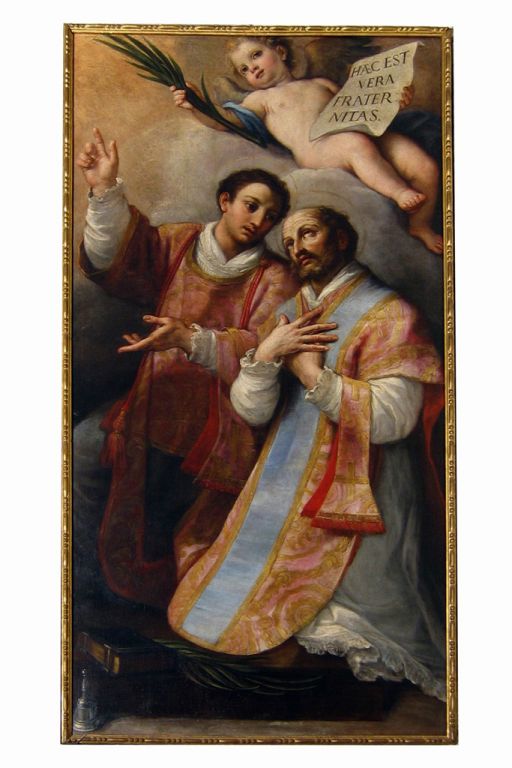
Faustinus and Jovita were brothers, nobly born, and were zealous professors of the Christian religion, which they preached without fear in their city of Brescia in Lombardy, during the persecution of Adrian. Their remarkable zeal excited the fury of the heathens against them, and procured them a glorious death for their faith.

Faustinus, a priest, and Jovita, a deacon, were preaching the Gospel fearlessly in the region when Julian, a pagan officer, apprehended them. They were commanded to adore the sun, but replied that they adored the living God who created the sun to give light to the world. The statue before which they were standing was brilliant and surrounded with golden rays. Saint Jovita, looking at it, cried out: “Yes, we adore the God reigning in heaven, who created the sun. And you, vain statue, turn black, to the shame of those who adore you!” At his word, it turned black. The Emperor commanded that it be cleaned, but the pagan priests had hardly begun to touch it when it fell into ashes.

The two brothers were sent to the amphitheater to be devoured by lions, but four of those came out and lay down at their feet. They were left without food in a dark jail cell, but Angels brought them strength and joy for new combats. The flames of a huge fire respected them, and a large number of spectators were converted at the sight. Finally sentenced to decapitation, they knelt down and received the death blow. The city of Brescia honors them as its chief patrons and possesses their relics, and a very ancient church in that city bears their names.


Collect:

O God, which makest us glad with the yearly festival of blessed Faustinus and Jovita, thy holy martyrs, grant, we beseech thee, that as we do rejoice in their merits, so we may be enkindled to follow them in all virtuous and godly living, through Jesus Christ our Lord. Amen.

Tuesday, February 14, 2012

Saint Valentine, priest and martyr, Feb. 14


Saint Valentine, priest and martyr, Feb. 14

From the Book on Ecclesiastical Writers by St. Jerome the Priest

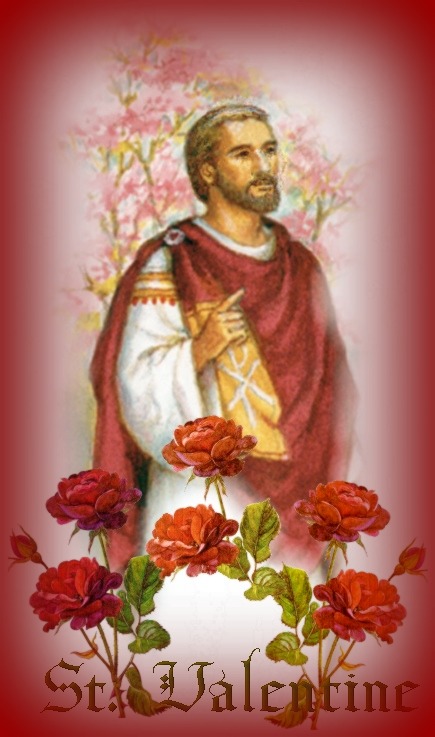
ON this day is commemorated blessed Valentine, a priest of Rome who was martyred for Christ, probably in the persecution of Claudius the Goth, about the year 259. He was buried on the Flaminian Way ; and about 350 a church was built over his tomb, and later a catacomb was constructed there under, wherein were buried the remains of many Martyrs. This church, with its cemetery, was the first to greet the eyes of pilgrims coming to Rome to visit the sepulchres of the ancient heroes of the Faith, and therefore his cultus grew, and spread through the world. But in the early years of the ninth century, his body was transferred to the basilica of St. Praxedes lest, being outside of the walls of the city, it should be desecrated by the Saracens. The popular story is that holy Valentine was cajoled with promises in order to wean him from Christ ; and that when these failed he was beaten with clubs, and finally beheaded. In England, from the time of Chaucer onwards, there was a belief that on his feast-day the birds began to choose their mates. From which arose the custom of arranging betrothals in Saint Valentine's Tide ; and in honour of the fidelity of the servant of God, those who were betrothed called each other Valentine, as a pledge of their mutual fidelity, in token that those who wed are united together in Christ, of whose unbreakable union with humanity in his Church, the Sacrament of Marriage is ever an outward and visible sign.

St. Valentine

Collect:
Grant, we beseech thee, Almighty God : that we who observe the heavenly birthday of blessed Valentine thy Martyr, may by his intercession be delivered from all evils that beset us. Through Jesus Christ thy Son our Lord, Who liveth and reigneth with thee, in the unity of the Holy Ghost, ever one God, world without end. Amen.