Welcome!

Thanks for visiting my blog! I hope it will serve to inspire you and perhaps inform you in some small way regarding the Holy Orthodox Faith or our Lord Jesus Christ. Feel free to comment or ask questions. Christ be with you!

Showing posts with label church. Show all posts

Tuesday, January 4, 2011

Saint Titus of Crete, Bishop and Confessor, Jan. 4

St. Titus, Bishop and Confessor, January 4
 
Titus was a gentile who became the disciple of the Apostle Paul, and was twice sent on missions to the Church in Corinth. Concerning this holy man, the Apostle wrote to the Corinthians : When I came to Troas to preach Christ’s Gospel, and a door was opened unto me of the Lord, I had no rest in my spirit, because I found not Titus my brother ; but taking my leave of them, I went from thence into Macedonia. Again, he wrote : When we were come into Macedonia, we were troubled on every side ; nevertheless God, that comforted those that are cast down, comforted us by the coming of Titus. * Paul, because of his regard for Titus, sent him to Corinth on a mission mainly concerned with the collection of alms from the charity of the faithful for the relief of the poor Hebrew Christians at Jerusalem. This mission Titus discharged with such wisdom and gentleness, that he not only strengthened the Corinthians in the Faith, but also stirred up in them an earnest desire, a mourning, a fervent mind toward Paul the earliest teacher. Many were the other journeys by land and sea which Titus undertook. Filled with boldness and zeal, he went with Paul to the island of Crete. Of this Church of Crete the Apostle himself made him the first Bishop ; and we may not doubt that, as such, he was what Paul bade him be : IN all things a pattern of good works, in doctrine, in uncorruptness, in gravity. * He is said to have sweated mightily to unfurl the banner of the Cross among the Dalmatians. And it is believed that, full of days and good works, upon a 4th of January, in the ninety-fourth year of his age, he died one of those deaths which are precious in the sight of the Lord; and that he was buried by the Church of which the Apostle had made him the minister. His praises have been mostly written by Saint John Chrysostom and Saint Jerome.

Antiphon on the Magnificat:
O holy Priest and Bishop, thou worker of so many mighty works, and good shepherd to Christ’s flock, * pray for us unto the Lord our God (alleluia).
 
Collect:
O God, who on thy blessed Confessor Saint Titus didst bestow the virtues of thine Apostles: grant, we beseech thee, that by his merits and intercession ; we may so live righteously and soberly in this world, that we may be found worthy to attain unto our country in heaven, through Jesus Christ our Lord. Amen.
Antiphon on the Benedictus:
Well done, good and faithful servant : thou hast been faithful over a few things, * I will make thee ruler over many things, saith the Lord (alleluia).

Friday, December 31, 2010

Saint Sylvester, Pope and Confessor

Saint Sylvester, Pope and Confessor
 
Sylvester, priest of the Church in the City of Rome, discharged his office with such praiseworthiness that in January, 314, he was chosen to succeed Saint Mechiades as Pope. Less than a year before this the Emperor Constantine had granted toleration to Christianity by the Edict of Milan. Sylvester established the Lateran Church, a gift to the Church in Rome from Constantine, as the Cathedral Church in that City. Several other great churches were founded during his pontificate, notably Saint Peter’s on Vatican Hill. It was also during his time that the Council of Arles was gathered out of divers provinces of Gaul, Italy, Africa, Spain, and Britain, to deal with the Donatist heresy. And, among other things, this Council ordered that Easter should be celebrated everywhere on one and the same day. In his time also was held the first Ecumenical Council, to wit, of Nicea in 325, to which he himself went not, but sent legates. Some three hundred and eighteen bishops were present, over whom Hosius of Cordova p0resided. And by these bishops, in the presence of Constantine, the Holy and Catholic Faith was declared, and Arius and his followers were condemned.
This Pope is reputed to have issued many useful ordinances for the Church of God : such as the reservation to bishops of the right of consecrating the holy Chrism and the custom of anointing the newly baptized therewith ; the wearing of a dalmatic and maniple by deacons; the consecration of the Sacrament of the Altar on a linen Corporal ; that all persons taking Holy Orders should remain a while in each grade before being promoted to a higher; that laymen should not go to law against clergy; and that clergy themselves were not to plead before civil tribunals.

To Sylvester is also ascribed the decrees that the first and seventh days of the week should be called respectively the Lord’s Day and the Sabbath; and the others, Second Feria, Third Feria, and so on, in accordance with the use of the word Feria for the week days which had already begun in the Church. This word signifieth an holy-day, and pointeth to the duty of the clergy to lay aside all worldly labour, and leave themselves free to do continually the work of the Lord. In 335 Sylvester went to God, and the date of his feast day is probably the anniversary of his burial, in the church which he built over the Catacombs of Saint Priscilla, on the Salerian Way. In 761 his relicks were translated to the Church of Saint Sylvester. His feast hath been general in the Latin Church since the thirteenth century, and is kept also in the East, because his pastoral concern for all Christians, everywhere, made him generally beloved. For he was Pope immediately after the Church came up out of the Catacombs into freedom. He reigned twenty-one years ten months, and one day.
Collect:
GRANT, we beseech thee, Almighty God: that we on this day devoutly observing the feast of thy holy Confessor Saint Sylvester, may thereby increase in godliness to the attainment of everlasting life, through Jesus Christ our Lord.

Tuesday, December 14, 2010

3rd Sunday of Advent Propers


MISSAL PROPERS:
THIRD SUNDAY OF ADVENT


INTROIT. Gaudete. Philippians 4:4-6
REJOICE in the Lord alway: and again I say, Rejoice: let your moderation be known unto all men: the Lord is at hand. Be careful for nothing: but in every thing, by prayer and supplication, with thanksgiving, let your requests be made known unto God. Ps. 85:1 Lord, thou art become gracious unto thy land: thou hast turned away the captivity of Jacob. V. Glory be.


COLLECT.
O LORD Jesus Christ, who at thy first coming didst send thy messenger to prepare thy way before thee: grant that the ministers and stewards of thy mysteries may likewise so prepare and make ready thy way, by turning the hearts of the disobedient to the wisdom of the just, that at thy second coming to judge the world we may be found an acceptable people in thy sight, Who livest and reignest with the Father and the Holy Spirit ever, one God, world without end. AMEN.

EPISTLE. 1 Corinthians 4:1-5
1 Let a man so account of us, as of the ministers of Christ, and stewards of the mysteries of God.
2 Moreover it is required in stewards, that a man be found faithful.
3 But with me it is a very small thing that I should be judged of you, or of man's judgment: yea, I judge not mine own self.
4 For I know nothing by myself; yet am I not hereby justified: but he that judgeth me is the Lord.
5 Therefore judge nothing before the time, until the Lord come, who both will bring to light the hidden things of darkness, and will make manifest the counsels of the hearts: and then shall every man have praise of God.

GRADUAL. Ps. 80. Shew thyself, O Lord, thou that sittest upon the Cherubims, stir up thy strength and come. V. Hear, O thou Shepherd of Israel: thou that leadest Joseph like a sheep.
Alleluia, alleluia. V. Stir up thy strength, O Lord: and come and help us. Alleluia

GOSPEL. St. Matthew 11:2-10
2 Now when John had heard in the prison the works of Christ, he sent two of his disciples,
3 And said unto him, Art thou he that should come, or do we look for another?
4 Jesus answered and said unto them, Go and show John again those things which ye do hear and see:
5 The blind receive their sight, and the lame walk, the lepers are cleansed, and the deaf hear, the dead are raised up, and the poor have the gospel preached to them.
6 And blessed is he, whosoever shall not be offended in me.
7 And as they departed, Jesus began to say unto the multitudes concerning John, What went ye out into the wilderness to see? A reed shaken with the wind?
8 But what went ye out for to see? A man clothed in soft raiment? behold, they that wear soft clothing are in kings' houses.
9 But what went ye out for to see? A prophet? yea, I say unto you, and more than a prophet.
10 For this is he, of whom it is written, Behold, I send my messenger before thy face, which shall prepare thy way before thee.

OFFERTORY. Ps. 85. Lord, thou art become gracious unto thy land: thou hast turned away the captivity of Jacob: thou hast forgiven the offence of thy people.

COMMUNION. Isa. 35. Say to them that are of a fearful heart: Be strong, fear not: behold your God will come and save you.

POSTCOMMUNION.
HAVE mercy upon us, O Lord, we beseech thee: and grant that the heavenly assistance of thy holy mysteries may so cleanse us from all our iniquities, that we may be made ready worthily to keep thy coming festival. [Through.]

Monday, December 13, 2010

Of Thy Mystic Supper O Son of God


This Chant is set to an Ambrosian chant tune. It is chanted immediately before the Communion in our parish.

Friday, December 3, 2010

Saint Bibiana, Virgin and Martyr

Saint Bibiana, Virgin and Martyr
 
Bibiana (also known as Viviana) hath been venerated as a virgin and Martyr since the earliest times. A church dedicated to her is known to have existed in Rome in the fifth century, which same is said to have been built by Pope Saint Simplicius. This saint suffered her passion in the reign of Julian the Apostate, and the tale is as follows: The family of Bibiana, being pre-eminent for Christianity, was marked for persecution. Hence her father, who had been prefect of Rome, was branded as a slave, and banished, shortly after which he was martyred. * His wife Dafrosa, and his two daughters, Bibiana and Demetria, were at first imprisoned and starved, and then Dafrosa was beheaded. Whereafter the two daughters were continually persecuted, in an attempt to keep them from imitating the unshakeable constancy of their holy parents ; and Demetria was so worn out by her sufferings that she suddenly dropped dead in the presence of the judge before whom she was making a brave witness to Christ. * Whereupon Bibiana was put in charge of an artful woman who had orders to seduce her, with promises of freedom if she would embrace a life of luxury and ill-fame. But she stedfastly refused such blandishments, and kept her virginity undefiled. Hence she was cruelly flogged to death, and her body left to be eaten by dogs. But a priest named John cam by night, and buried her remains near the graves of her holy mother and sister, nigh to which place was built the church named for her. And Urban VIII, when he restored this ancient temple is said to have placed the relicks of all three of these holy women under the high altar.
 
Antiphon on the Magnificat:
Come, thou bride of Christ, receive the crown, * which the Lord hath prepared for thee for ever (alleluia).
Collect:
O God, the giver of all good gifts, who didst bestow on thy servant Bibiana both the flower of virginity and the palm of martyrdom : we pray thee, that, by her intercession, our hearts may in such wise be joined in charity unto thee, that we, being defended against all dangers, may attain unto the rewards of everlasting salvation, through Jesus Christ our Lord. Amen.
 
Antiphon on the Benedictus:
The kingdom of heaven is like unto a merchantman seeking goodly pearls, * who when he had found one pearl of great price, went and sold all that he had and bought it (alleluia).

Thursday, December 2, 2010

Saint Peter Chrysologus, Bishop, Confessor, Doctor

Saint Peter Chrysologus, Bishop, Confessor, Doctor
 
Peter ( on account of his eloquence surnamed Chrysologus, which is Greek for Him-of-the -golden-words) was born in Imola, near Ravenna and very early displayed a leaning to godliness. Wherefore Cornelius, Bishop of Imola, soon ordained him deacon. On the death of the Archbishop of Ravenna, Saint Pope Sixtus III ( so it is said ) was warned in a dream to consecrate this deacon to that post, and thereupon refused to ratify the election made by the people of Ravenna, but consecrated the unwilling Peter instead. The Emperor Valentinian and the Empress-Mother Galla Placidia lived in Ravenna, and the young Archbishop soon won their confidence, and well as that of the successor to Saint Sixtus III, who was Pope Saint Leo the Great. * Now there was much paganism left round about Ravenna, and many abuses had crept in amongst the faithful. Wherefore Peter strove mightily for Christ, building splendid churches, caring for the poor, and above all preaching the Gospel. He once preached a most severe sermon against the revelries of New Year’s Day, in which he said : He that jesteth with the Devil shall never rejoice with Christ. In his preaching he was wont to recommend frequent Communions, that the Body of Christ might be our daily bread. In 708, and hundred and seventy-six of his discourses were collected, which same are still extant, all of them being brief, for he feared to weary his hearers. * It is said that when he preached his vehemence was such that he sometimes became speechless with excitement. Moreover, his hearers were not seldom moved to tears, cries, and prayers. By command of Pope Saint Leo, he addressed an Epistle to the Council of Chalcedon against the heretick Eutyches, and also confuted him in another letter addressed to Eutyches himself. When he had ruled the Church in Ravenna for about eighteen years, he passed in peace to a better life, on December 2nd, about 450, at Imola ; whither he had gone, forewarned by God, to prepare himself for his death ; and where his holy body was buried, hard by the remains of his chosen patron Saint Cassian the Schoolmaster.
 
Antiphon on the Benedictus:
Well done, good and faithful servant: thou hast been faithful over a few things, I will make thee ruler over many things, saith the Lord (alleluia).
Collect:
O God, who by divine foreshowing wast pleased to summon thy great teacher Saint Peter Chrysologus to be a ruler and Doctor of thy Church : grant, we beseech thee, that, as we have learned of him the doctrine of life on earth, so we may be found worthy to have him for our advocate in heaven, through Jesus Christ our Lord. Amen.


Antiphon on the Magnificat:The Lord loved him and adorned him, he clothed him with a rove of glory, * and at the gates of Paradise he crowned him (alleluia).
 

Sunday, November 21, 2010

November 21, Presentation of Our Lady in the Temple

From the Book on Orthodox Faith by St. John of Damascus

Entry of Our Lady in the Temple
Joachim took to wife that most eminent and praiseworthy woman, Anne. And even as before her time the holy Hannah (being stricken with barrenness ) by prayer and promise became the mother of Samuel, so likewise this holy Anne, through prayer and promise, received from God the Mother of God, that in fruitfulness she might not be behind any of the famous matrons. And thus Grace ( for such is the signification of the name Anne) is mother of the lady ( for such is the signification of the name of Mary). And indeed this child of grace became the Lady of every creature, since she hath been Mother of the Creator. She first saw the light in Joachim’s house, hard by the Pool of Bethesda, at Jerusalem, and was carried to the temple. There planted in the Lord, the dew of his Spirit made her to flourish in the courts of her God, where she was like unto a green olive tree, so that all the doves of grace came and lodged in her branches. And there she in such wise raised her mind utterly above the pride of life, and the lust of flesh, that she kept her soul virgin in her virgin body, as became her that was to receive God into her womb.


From the Treatise Concerning Virgins by Saint Ambrose the Bishop
 
Such was Mary that her single life offered an ensample to all. If then we be not displeased by the doer, let us applaud the deed ; if any other woman seek like reward, let her follow after like works. In the one Virgin how many glorious examples do shine forth. Hers was the hidden treasure of modesty, hers the high standard of faith, hers the self-sacrifice of earnestness, hers to be the pattern of maidenhood at home, of kinswoman hood in ministry, of motherhood in the temple. O to how many virgins hath she been helpful! How many hath she taken in her arms and presented unto the Lord, saying : here is one who, like me, hath kept stainless clean the wedding chamber, the marriage-bed of my Son.


St.Ambrose
Why should I go on to speak of the scantiness of her eating, or the multiplicity of her work? How her labour seemed above human capacity, and her refreshment insufficient for human strength ; how her toil never missed a moment, and her fasting took as much as two days together? And when she was fain to eat, she took not dainties, but whatsoever food came first to hand that would keep body and soul together. She would not sleep till need was, and even then, while her body rested, her soul watched. I opine that often she talked in her sleep, either repeating things that she had read, or going on with what she was doing before sleep interrupted her, or rehearsing things executed, or talking of things projected.


Antiphon on the Benedictus:
Blessed art thou O Mary, for that thou hast believed, * and there shall be a performance in thee of those things which were told thee from the Lord.
 
Collect:
O God, who on this day didst vouchsafe that blessed Mary Ever-Virgin, the dwelling-place of the Holy Ghost, should be presented in the Temple : grant, we beseech thee, that by her intercession we may be found worthy to be presented unto thee in the temple of thy glory, through Jesus Christ thy Son our Lord, who in the unity of the same Holy Ghost, liveth and reigneth with thee, world without end. Amen.
Antiphon on the Magnificat:
O holy Mary, help thou the suffering, strengthen the faint-hearted, comfort the sorrowful ; pray for the people, plead for the clergy, entreat for all women dedicated to God * let everyone that keepeth holy-day in thine honour know the benefit of thine intercession (alleluia).


Tuesday, November 2, 2010

Video Presentation: All Saints Propers

Here is a video featuring two lessons and the Introit and Gradual. It was a tremendous joy last evening to praise God in His saints, so innumerable as the sands of the seashore, at the Mass last night. Hoping all have enjoyed a blessed and profitable Feast!  May this humble video be a taste of our celebration, and a means of grace for faithful souls.

All Saints Day Chants & Lessons : Youtube

Monday, November 1, 2010

All Saints Day Propers, Collect, and Lesson

A Homily by Saint Augustine the Bishop

All Saints
If it be asked what is signified by the mountain, the same may well be understood to indicate the higher and greater commandments of righteousness, since those that were given to the Jews are the lesser. In an excellent order of dispensations, the one and the same God gave, by his servants the holy Prophets, his lesser commandments unto the people that still had need to be bound by fear ; but by his Son he gave the greater to the people whom it was expedient now to set free by love. But whether it be the lesser to the lesser, or the greater to the greater, all are alike the gift of him who alone knowest what is in each epoch the seasonable medicine for mankind.
Need we than be surprised that the greater commandments were given for the kingdom of heaven, and the lesser for a commonwealth on earth? For both are gifts of that one God who is the Maker alike of heaven and of earth. The higher and greater righteousness is that whereof the Psalmist saith: Thy righteousness standeth like the strong mountains. And this may be taken mystically to mean that the teaching given from the mountain is from that Master who alone can give teaching of such strength. In this connection note how the Gospel saith : And when he was set, (which posture indicateth the majesty of his instructions,) his disciples came unto him. That is , they came nearer in the flesh, to hear those precepts by the fulfillment of which they should be nearer in spirit. Then saith the Gospel : He opened his mouth, and taught them. These words : He opened his mouth : appear to e redundant. It may be that this more extended introduction is adopted on account of the exceptional length of the discourse to follow. But it may also be that these words are not really redundant, but the pointed declaration that he now opened his own mouth, who under the old Law, had been used to open the mouths of the Prophets.
And then what saith he? Blessed are the poor in spirit, for theirs is the kingdom of heaven. The Book of the Preacher saith, concerning lusting after temporal things : The wandering of the desire is vanity and vexation of spirit. [Or, as it may be rendered, Vanity and striving after wind.] For the wandering desires which bestir the spirit into vexation do but result in rashness and pride. We are used to say of proud people that they are men of high spirit. And we say well, since one of the words for Wind in Latin is Spirit. [That is, Spiritus, which is the word for Breathing or Blowing.] It is so used, for instance, by the Psalmist : Fire and hail, snow and vapours, Wind and storm : [where the word Wind in Latin is Spiritus]. Who hath not heard the proud spoken of as puffed up, as if they were blown out with wind? Hence also the Apostle saith : Knowledge puffeth up, but charity edifieth. By the poor in spirit, who are here called blessed, are rightly to be understood such as are lowly and fear God, that is, have not minds puffed up with windy vanity.
 
 
Antiphon on the Benedictus:
The glorious company of the Apostles praise thee; the goodly fellowship of the Prophets praise thee; the white-robed army of Martyrs praise thee; * all thy Saints and Elect with one voice do acknowledge thee, O blessed Trinity, One God.
Antiphon on the Magnificat:
O how glorious is the kingdom wherein all the Saints rejoice with Christ; * arrayed in white robes they follow the Lamb withersoever he goeth.
Collect:
O ALMIGHTY God, who hast knit together thine elect in one communion and fellowship, in the mystical body of thy Son Christ our Lord; Grant us grace so to follow thy blessed Saints in all virtuous and godly living, that we may come to those unspeakable joys which thou hast prepared for those who unfeignedly love thee; through the same thy Son Jesus Christ our Lord. Amen.

Feast of Christ the King : Video Presentation

Yesterday, being the last Sunday in October, is Commemorated as the Feast of Christ the King. No earthly sovereign surpasses the authority of Christ, or his loving care for the people of the Earth. Being both creator and sustainer of all things in creation, the Lord Christ, also having redeemed man that fell from innocence and perfect communion with God by his own sin, has received all power in heaven and earth.

The efforts of even the best of humanity fall woefully short of the superintending grace and love of heaven, and when given no restrictions, we see human governments depriving God's subjects of the due rights. Thus we should ever bear in mind the righteous dominion of the King of Kings, Jesus Christ the Lord.

Youtube : The Feast of Christ the King.

Monday, October 11, 2010

Lessons Antiphons and Collect for Saint Wilfrid, B.C.

Saint Wilfrid, B.C.

Wilfrid, at the age of thirteen, left home to escape from mistreatment by his stepmother ; and thenceforth he found little peace on earth ; for he fought vigorously all his life long to bring the Christians of England who followed the peculiar national Celtic customs into accord with the more general usages of the Western Church under the Roman See. Being the son of a Northumbrian thane, he went first to the court of King Oswy, and thence was sent, at the age of fourteen, to Lindisfarne and Whitby for instruction in divine science. He also studied the Roman usages at Canterbury ; and in 654 set out for Rome with Saint Benedict Biscop on the latter’s first journey to the eternal city. There he tried to perfect himself in holy things, and was finally made secretary to Pope Saint Martin. When he returned to England, Aldfrid, son of Oswy, appointed him to instruct the Northumbrians in the Roman usages, for that prince liked not the Celtic customs concerning the date of Easter and various other matters, any more than did Wilfrid. And when Aldfrid required the monks whom he had placed in his newly-built monastery at Ripon to give up their peculiar Celtic usages, many of them returned to their former monastery of Melrose ; whereupon Wilfrid was made Abbot of Ripon * Now when the dispute regarding the two ecclesiastical observances became more acute, a synod was held at Whitby to decide the matter. For the Celtic party said that their usages came through France from the tradition which Saint John the Evangelist had established in Asia Minor, whereas the Roman party claimed the authority of the Prince of the Apostles for their customs. And when most of those present at the council decided in favour of Roman canon law and discipline, the others withdrew from work in Northumbria, and retired to the holy island of Iona. Whereafter Wilfrid was chosen Bishop of the Northumbrians, and went to Paris for consecration, for he held the neighboring bishops as schismatics. But he was so long delayed on this journey that King Oswy grew impatient, and had Saint Chad consecrated in his stead. Which was the occasion of fresh controversy when Wilfrid returned and went to live in his Abbey of Ripon. However, in 699 Saint Theodore, Archbishop of Canterbury, set him up as Bishop of York, and Chad went to work among the Mercians. But Wilfrid incurred the enmity of Egfrid, after the latter became King, which same moved Saint Theodore to divide the northern territory into four dioceses, leaving one for Wilfrid, and intruding three others into the rest of Wilfrid’s former jurisdiction. * Then was made the first appeal to the Roman See, namely, from Wilfrid as Bishop of York against the Archbishop of Canterbury ; to which end Wilfrid set out for Rome a second time. And on his way thither he preached the Gospel mightily in Friesland, converting many heathens, and thereby opening the way for the harvest of souls which Saint Willibrord and his companions gathered in. Now when Pope Saint Agatho had decided the case in Wilfrid’s favour, he returned to King Egfrid with the decree, who promptly cast him into prison, and kept him there many months. And when he was set free he was obliged to flee from one place to another, until he came into the region of the South Saxons. There he settled down, and laboured greatly in the Gospel, converting many, and establishing a bishoprick which afterwards became the See of Chichester. But in 686, after King Egfrid had died, Wilfrid was recalled to York, through the intervention of Saint Theodore and others. However, so many difficulties arose that he went to Rome for a third time, to make a second appeal to the Holy See. As a result of which he was again, by papal decree, awarded all his former authority in Northumbria. But he was seventy-two years old, and shortly thereafter died in peace, namely, on April 24th, 709. But his feast is usually kept on October 12th, being the day of the translation of his relicks.

Antiphon on Benedictus
Good and faithful servant, enter thou * into the joy of thy Lord.(Alleluia).

 
Antiphon on Magnificat
O holy Priest and Bishop, thou worker of so many mighty works, and good shepherd to Christ’s flock, * pray for us unto the Lord our God (Alleluia).

Collect:

O God, who by reason of the singular merits of thy blessed Bishop Saint Wilfrid, didst cause to shine forth in him many wondrous works, we beseech thee, mercifully to grant, that like as we have learnt from his teaching to seek earnestly after all things heavenly, so we may at all times be defended by his intercession, through Jesus Christ thy Son, our Lord, who liveth and reigneth ever one God, world without end. Amen.

Motherhood of Our Lady, October 11

The Feast for which the following Lesson and Collect are appointed is not strictly speaking of an Orthodox origin. No Orthodox authorities have, to my knowledge, set forth this day to commemorate this feast, but it is a feast primarily intended to acknowledge the great truth recognized and codified in the decision of the Ecumenical Council of Ephesus  in 431 AD, against the Nestorians, and which declared that the Blessed Virgin Mary was rightly to be called Theotokos, "God-Bearer." For these reasons, though it is not to be considered an Orthodox commemoration, I have posted these for your perusal and edification.

A Sermon from Saint Leo the Pope

ST. LEO THE GREAT
The Virgin royal of the lineage of David was chosen to become fruitful with the divine Offspring. For she who was thus chosen to bear the God-Man had already conceived Christ her soul before she conceived him in her body. And first she learned the counsel of God from the Angel, lest the unwonted events should alarm her. So the future Mother of God knew what was to be wrought in her by the Holy Ghost, and that her honour would in no way be lost. For why should she, unto whom was promised all-sufficient strength through the power of the Highest, feel hopeless merely because of the unexampled character of such a conception? Nay, she believeth, and her belief is confirmed by the attestation of a miracle which hath already been wrought, namely, that Elizabeth receiveth fruitfulness, before unhoped for. Hence she might not doubt that God, who had given conception unto one that was barren, would give the same unto her that was virgin. And so the Word of God, (the Son of god, who was in the beginning with God, by whom all things were made, and without whom was not anything made that was made,) was made man to deliver man from eternal death.
Our Lord Jesus Christ, descending from his throne in heaven, but leaving not that glory which he hath with the Father, cometh into this lower world y being born after a new order and in a new kind of birth. He cometh after a new order, in that he who is unseen of us in his own nature was seen amongst us. Thus the Incomprehensible was fain to be comprehended. And he that is from everlasting to everlasting began to be in time. And by a new kind of birth was he begotten: conceived of a Virgin and born of a Virgin ; without the intervention of any fleshly father ; without any breach of his mother’s virginity. For such a birth beseemed the coming Saviour of mankind who was to have in him the nature of man’s being and to be free of any defilement of man’s flesh. Though he sprung not as we spring, yet is his nature as our nature. We believe that he is free from the use and wont of men, in that it was the power of God which wrought this ; namely, that as a Virgin she conceived, as a Virgin she brought forth, and yet abode she Virgin still.

DIVINE MOTERHOOD
Collect:
O God, who didst vouchsafe that thy Word should be made flesh in the womb of the Blessed Virgin Mary at the message of an Angel, grant to us thy humble servants, that we, believing her to be indeed the Mother of God, may by her intercession find favour in thy sight, through the same Christ our Lord. Amen.

Thursday, October 7, 2010

Lesson from the Divine Office Lectionary

The lectionary for the morning prayer office currently has as the second scripture lesson the Epistle of St. James. For today the passage was as follows…

What doth it profit, my brethren, though a man say he hath faith, and have not works? can faith save him? If a brother or sister be naked, and destitute of daily food, And one of you say unto them, Depart in peace, be ye warmed and filled; notwithstanding ye give them not those things which are needful to the body; what doth it profit? Even so faith, if it hath not works, is dead, being alone. Yea, a man may say, Thou hast faith, and I have works: shew me thy faith without thy works, and I will shew thee my faith by my works. Thou believest that there is one God; thou doest well: the devils also believe, and tremble. But wilt thou know, O vain man, that faith without works is dead? Was not Abraham our father justified by works, when he had offered Isaac his son upon the altar? Seest thou how faith wrought with his works, and by works was faith made perfect? And the scripture was fulfilled which saith, Abraham believed God, and it was imputed unto him for righteousness: and he was called the Friend of God. Ye see then how that by works a man is justified, and not by faith only. Likewise also was not Rahab the harlot justified by works, when she had received the messengers, and had sent them out another way? For as the body without the spirit is dead, so faith without works is dead also.
It’s fun watching our Protestant friends, committed to the doctrine of “justification by faith alone,” twisting themselves into pretzels trying to make this passage not mean what it so obviously means. Some of their attempts are actually funny.

I have a grudging respect for how Martin Luther dealt with the plain teaching in the passage of St. James’s epistle. He didn’t try to make it say something it clearly wasn’t saying, he just more or less said, “it doesn’t fit with how I understand the rest of the New Testament, so it must not be truly inspired scripture.” Luther called James an “epistle of straw,” an illusion to St. Paul’s wood hay or stubble teaching in Corinthians, or maybe he was saying it was only good for the barn floor. At least he could tell what it really was saying and didn’t try to contort it into supporting a believe only doctrine of Justification, which since has become the typical Protestant strategy.


Protestants are in trouble beginning with verse 14. “
We certainly saved by grace, but not by believing only. As James tells us, “
What doth it profit, my brethren, though a man say he hath faith, and have not works? can faith save him?” In it’s context and given the flow of thought that follows, it is easy to see this is a rhetorical question, to which the expected conclusion is “no!” The following verses are not an excursion into instruction in Christian charity, they are an illustration of the point being made. When people are naked and hungry they can’t wear or eat your words, which words have no real effect, unless it’s to underscore the vanity of the platitude. In short, talk is cheap, it’s works that matter. The entire passage is like this, and our poor Protestant brothers go on trying to fit them somehow into the straightjacket of the solas.the devils also believe, and tremble.“

Saturday, October 2, 2010

Funny is funny, isn't it?


I love to watch Rowan Atkinson’s skit in which he plays the Devil welcoming new souls to hell. Atkinson’s timing is impeccable, and delivery flawless. I loved him in the Blackadder series, and Mr. Bean, and this is really more of the same first rate comedy.

He spares no one including us Christians, and it is one of the funniest routines I have ever seen. “Ah hello, its good to see you all here,” as if the devil would be so genteel and polite. He greets them, and tells a joke to break the tension, then begins dividing them into groups based on their sin of choice. “Adulterers over here and all other fornicators over there. Male adulterers if you would just form a line in front of that small guillotine in the corner.” Atkinson's Devil Welcome


I’ve watched it multiple times, and always enjoy it, but maybe I shouldn’t enjoy it. An eternity in hell is a real possibility facing every soul born into the world. If I laugh at these jokes do I in some way reject or diminish the awful finality, or the unremitting anguish and suffering of hell? Do I by my levity lead an uninstructed soul to the notion that there is nothing to fear in a life of sin?
We don’t appear to need comedians to go about diminishing the reality of hell, there are plenty of ministers that are downright anxious to do the job. I guess polite society doesn’t care for a god that is mean and sends people to hell. But what did our Lord say on that topic? “And I say unto you my friends, Be not afraid of them that kill the body, and after that have no more that they can do. But I will forewarn you whom ye shall fear: Fear him, which after he hath killed hath power to cast into hell; yea, I say unto you, Fear him.” (Luke 12:4-5 King James Version)

I think if the Lord Jesus says, “fear him,” its probably sound advice.
Are we to fear real fire and pain in hell? Many say not. Yet our Lord told a story, some say it is a parable, but then again the Lord gives names to the characters of the story, but does not in any other parable, and in this story, “And in hell he lift up his eyes, being in torments, and seeth Abraham afar off, and Lazarus in his bosom. And he cried and said, Father Abraham, have mercy on me, and send Lazarus, that he may dip the tip of his finger in water, and cool my tongue; for I am tormented in this flame.” (Luke 16: 24-25 King James Version)
Sounds for all the world to me like a real place with real fiery torment, not just psychological angst, and separation from God only.


Friday, October 1, 2010

Saint Remigius Bishop, Confessor, October 1st

Remigius, also called Remi, is reverenced as the Apostle of the French. He came from a distinguished Christian family: for the title of Saint is in France commonly given to his mother Cilinia ; to his older brother Principius, Bishop of Soissons ; to the son of the latter, named Lupus ; and to his nurse Balsmia. Thus in boyhood he was surrounded with holy people, and grew up both godly and learned. Saint Sidonius Apollinaris, who knew him well, saith he was the most eloquent man of his age. When he was only twenty-two, and still a layman, he was chosen by acclamation to be Bishop of Rheims, and thereafter set out to spread the Gospel widely among the Franks. Now Clovis, King of the Franks, was an heathen, rude and cruel. And Saint Clotilde, his wife, prayed long to bring him to Christ. Finally divine grace prevailed, and under the joint instruction of Saints Vedast and Remigius, not only Clovis, but many of his kinsfolk and army as well, were prepared for Baptism, some three thousand in all, it is said. A story is told of Clovis, that during the instruction which he was given concerning the Passion of our Lord, he grasped his weapons, and stood up in anger, and exclaimed that such injustice would not have happened if the had been there with his warriors! And at the laver of regeneration, blessed Remigius is reputed to have charged Clovis, saying : Bow down thy head, O Sicambrian! Adore what thou hast burned, and burn what thou hast adored. Thenceforward great progress was made in the spread of the Gospel among the Franks ; and after more than three score and ten years as bishop, full of good works and famous for miracles, blessed Remigius died on January 13th, about the year 533. But his feast is kept on October 1st, being the day when Saint Pope Leo IX, in 1049, translated his relicks to the great Abbey in Rheims.


Antiphon on the Benedictus:
Well done, good and faithful servant: + thou hast been faithful over a few things, I will make thee ruler over many things: * enter thou into the joy of thy Lord (Alleluia.)

Collect:
Grant, we beseech thee, Almighty God : that the devout observance of this festival of blessed Remigius, thy confessor and Bishop, may be profitable unto us for our advancement in all godliness, and for the attainment of everlasting salvation. Through Jesus Christ, thy Son our Lord, who liveth and reigneth with thee, and the Holy Ghost, ever one God, world without end. Amen.


Wednesday, September 29, 2010

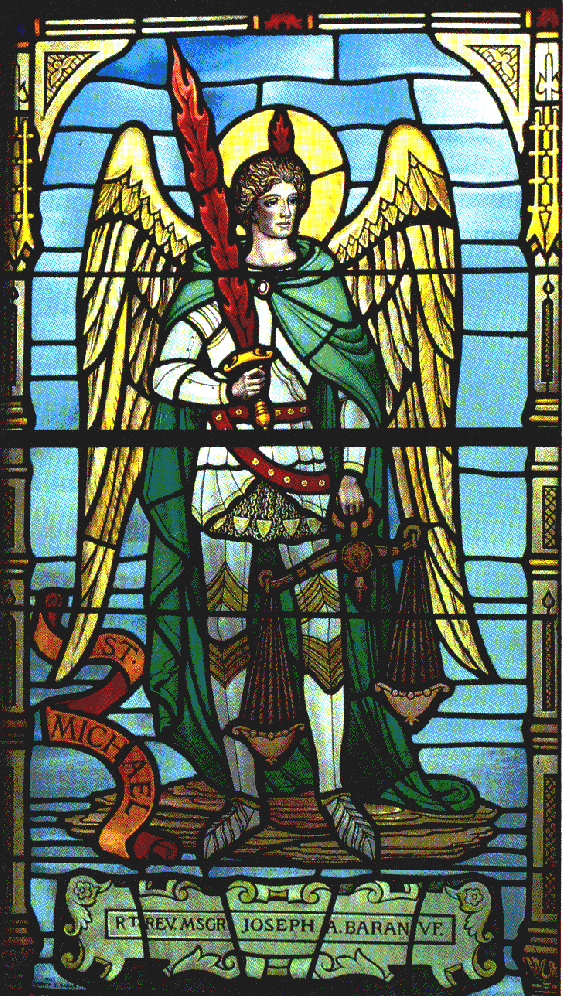
St. Michael and All Angels

St. Michael and All Angels
From a sermon by St. Gregory the Pope
We are accustomed to speak of nine choirs of Angels, because holy Writ seemeth to witness to that number when it speaketh severally of Angels, Archangels, Mights, Powers, Principalities, Dominions, Thrones, Cherubim and Seraphim. Very many pages of holy Writ witness to Angels and Archangels. The books of the Prophets, as is well known, do often make mention of Cherubim and Seraphim. Paul, writing to the Ephesians, counteth up the names of four choirs, where he saith that Christ is set far above all Principality, and Power, and Might, and Dominion. Again, writing to the Colossians, he speaketh of Thrones as well as of Dominions, Principalities, and Powers. If then we add the Thrones to the four choirs mentioned to the Ephesians, we have five choirs. And when we add unto them the Angels and Archangels, the Cherubim and the Seraphim, we com to the final conclusion that there are nine choirs of Angels.
Now it must be understood that the word Angel is the name of an office rather than the designation of the nature of these beings. For those holy ones of heaven are always spirits, but they are not always accurately called Angels, which is, being interpreted, Messengers, for they are Angels only when they are sent as Messengers. Hence also it is said by the Psalmist : He maketh his Angels spirits, and his Ministers : as if to indicate that he hath made them spirits, and that of these spirits he sometimes maketh some to minister in the office of messenger. They that go on a lesser ambassage are called Angels, that is Messengers. They that go on a great ambassage are called Archangels, that is Chief Messengers. Hence it is that unto the Virgin Mary was sent no common Angel, but the Archangel Gabriel. For the delivery of this, the highest message, it was meet that there should be sent one of the highest Angels. Their individual names also are so given as to signify the kind of ministry wherein each is powerful. Michael is by interpretation : Who is like unto God? Gabriel: The Strength of God. Raphael : the Medicine of God. As often as anything very mighty is to be done, we see that Michael is sent, that by that very thing, and by his name, we may remember that none is able to do as God doeth. Hence that old enemy, whose pride hath puffed him up, so that he is fain to be like unto God, is reported by the Prophet Isaiah to have said : I will ascend into heaven; I will exalt my throne above the stars of God; I will be like the Most High. But this old enemy, when at the end of the world he is about to perish in the last death, having no strength but his own, is shewn unto us a-fighting with Michael the Archangel, even as saith John in the Apocalypse : There was war in heaven ; Michael and his Angels fought against the dragon ; and the dragon fought and his angels. Unto Mary is sent Gabriel, whose name signifieth Strength of God, for he came to herald the coming him who was content to appear lowly that he might fight down the powers of the air. Raphael, whose name signifieth Medicine of God, is the one who, as a physician, treated the eyes of Tobit, so that his blindness was cleared away.
 
Antiphon on the Benedictus:
There was silence in heaven for a space, whenas Michael and his Angels made war against the dragon, * and Michael waxed valiant in fight, and turned to flight the armies of the contrary part (Alleluia)
Collect:
O EVERLASTING God, who hast ordained and constituted the services of Angels and men in a wonderful order; Mercifully grant that, as thy holy Angels always do thee service in heaven, so, by thy appointment, they may succour and defend us on earth; through Jesus Christ our Lord. Amen.
 

Friday, September 24, 2010

Our Lady of Mercy and Ransom, September 24

Our Lady of Mercy and Ransom
In the early part of the thirteenth century, much of Spain lay crushed under the yoke of the Saracens. By whom countless numbers of the faithful were held in brutal slavery, with the lively danger of being made to deny, and so to forfeit, everlasting salvation. Amid such sorrows as these a wealthy and godly man, Peter Nolasco, was earnestly pondering within himself how he could succour so many suffering Christians dwelling in bondage to the Moors. And it is related that the Blessed Virgin appeared to him, and told him that it would be well-pleasing to her Son, if an Order were founded in her honour, for the purpose of redeeming prisoners from their slavery to the infidels. Strengthened by this heavenly vision, the man of God (so it is said ) began to burn with the desire that he himself, and the Order which he should found, might exercise that live, greater than which hath no man, that a man lay down his life for his friends.
Upon the same nigh (so the story hath it) the Virgin also appeared to Saint Raymund of Pennaforte, and to King James of Aragon, charging them concerning the funding of the Order. Now it happened that Peter had for his confessor this same Raymund, to whose governance he right humbly submitted himself. Then came King James, and the three took counsel together, and all with one consent entered upon the institution of an Order, under the invocation of Saint Mary of Ransom, for the redemption of captives.
From lack of historical records, no verification of the foregoing stories is possible, but it is known that Peter Nolasco founded such an Order. The brethren whereof took (in addition to the vows of poverty, chastity, and obedience) a fourth vow, whereby they bound themselves to give themselves in pawn to the unbelievers, if need so required, for the liberation of Christians from their bondage, and this Institute, under the Blessed Virgin’s patronage, spread through all the world. That due thanks might be rendered for the many mighty works which have come to pass form these examples of Christian charity, this Feast of our Lady of Mercy hath been instituted, and is become the titular feast of those works of mercy undertaken under her patronage.

Collect
O God, who through the most glorious Mother of thy Son didst vouchsafe to increase thy Church with a new offspring for the redemption of thy Christian people from the powere of the heathen : grant, we beseech thee, that like as we on this day do honour her for the work of her institution, so by her merits and intercession we may be delivered from all our iniqiuties and the bondage of the devil, through the same thy Son, Jesus Christ our Lord. Amen.

Sunday, September 19, 2010

Sings like an angel BUT.

Well of course I was delighted that my daughter Elizabeth came with us to Liturgy this morning and I pray it will lead to her joining formally, but a side effect was that, since her boon friend was in attendance, my daughter Cecilia opted to stay in the pew for intermittent chatting, in luie of singing with us in choir. Cecilia has tended all her life to rely greatly on the companionship of her sister, and doesn't very often step out on her own. It's funny also, because she sometimes resents Lizzie's independence and greater ability to connect with other kids and risk the rejection and whatnot.

Cecilia really ought to sing in choir because she has a nice voice and she sings in the school choir, but I guess it is a small price to pay if Lizzie will come regularly and convert to the Faith.

The weekly struggle.

Am I alone or do other orthodox parents (or in my case, parent, singular) struggle to get their children ready for Sunday morning services? And in this case I am only speaking of the temporal kind of readiness; awake, appropriately clothed, combed, teeth brushed, etc. There is of course the more critical spiritual prepardness, which I confess this week I may not have accomplished even for myself. I have to begin getting them to select clothes the day before so that there won't be a debate over what is appropriate attire for God's house on the Lord's Day (or any day really.) One victory I have been given this morning; my oldest daughter is coming with us. May the Lord grant that this be a new beginning to a completed sojourn for her to Christ's Orthodox Catholic Church.