Welcome!

Thanks for visiting my blog! I hope it will serve to inspire you and perhaps inform you in some small way regarding the Holy Orthodox Faith or our Lord Jesus Christ. Feel free to comment or ask questions. Christ be with you!

Friday, July 22, 2011

July 22, Saint Mary Magdalene

From a Sermon by St. Gregory the Pope


When even Christ’s disciples went away to their own homes, Mary Magdalene still stood without at his sepulchre, weeping. She sought him whom her soul loved, but she found him not. She searched for him with tears, and yearned with strong desire for him who (as she believed) had been taken away. And this it befell her that being the only one who had remained to seek him, she was the only one that saw him. How true it is that the backbone of a good work is perseverance. At first when she sought him, she found him not. But she went on searching, and so it came to pass that she found him. And this was so, to the end that her longing might grow in earnestness, and so in its earnestness might find what it sought. Hence is it that the Bride in the Song of Songs saith as representing the Church : By night on my bed I sought him whom my soul loveth. We seek on our bed for him whom our soul loveth, when, having got some little rest in this world, we still sigh for the presence of our Redeemer. But it is by night that we so seek him, for though our mind may be on the alert for him, yet still he is hidden from our eyes by the darkness that now is.

But if we find not him whom our soul liveth, it remaineth that we should rise and go about the city ; that is, by thought and questioning, go through the holy Church of the elect. We should seek him in the streets, and in the broad ways; that is , walk, anxiously looking about us, both in the narrow and the broad places, if so be, that we may find his footsteps there ; for there be some even of those who live for the world, from whom the godly may learn a thing or two worth imitating. As we this go wakefully about, the watchmen, that keep the city, find us ; that is, the holy Fathers (who are in effect the Church) come to meet our good endeavours, and to teach us either by their words or by their writing. And it needeth but little to pass form them, but w3e find him whom our soul loveth ; that is, even by passing through a little of their teaching, we may find our Redeemer. For he in lowliness became as a man among men, yet by right of his divine nature he is still above them.


Collect:
O Almighty God, whose blessed Son didst call and sanctify Mary Magdalene to be a witness to his resurrection : mercifully grant that by thy grace we may be healed of all our infirmities, and always serve thee in the power of his endless life, through the same Jesus Christ thy Son our Lord, who liveth and reigneth with thee and the Holy Ghost, one God, unto ages of ages. Amen.

Thursday, July 21, 2011

July 21st, Saint Praxedes, Virgin.

Apse of the Church of St. Praxedes
July 21st, Saint Praxedes, Virgin.


This Praxedes (as we know from ancient records ) was a maiden of Rome in the second century who was buried in the Cemetery of holy Priscilla, next to the maiden Pudentiana, who is therefore reputed to be her sister, and whose Legend is given on May 19th. The story that hath been told for many centuries concerning Praxedes is that she constantly assisted with money, labour, comfort, and every helpful office of Christian charity, all those Christians whom the Emperor Marcus Antoninus was at that time hunting down like wild beasts. Some she his in her house, some she exhorted to firmness in professing the Faith, of some she buried the bodies. For those in prison, and those toiling in slavery, she supplied every need. At last the sight of such butchery of Christians was more that she could bear, and she implored God that she might die, if it were expedient for her so to do, and to be released form such suffering. And on July 21st, she went to god. Whereupon Pastor the Priest, so it is said, laid her body in the double-grave of her father and sister, and Saints Pudens and Pudentiana, in the cemetery of Saint Priscilla.


Collect:
Graciously hear us, O God of our salvation : that, like as we do rejoice in the festival of thy blessed Virgin Saint Praxedes, so we may learn to follow her in all godly and devout affections, through Jesus Christ our Lord. Amen.

Wednesday, July 20, 2011

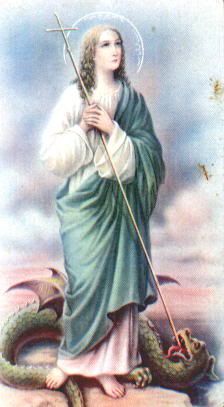
July 20th, Saint Margaret of Antioch, Virgin and Martyr


St.Margaret of Antioch
 

July 20th, Saint Margaret of Antioch, Virgin and Martyr


This Margaret is one of the most widely venerated Saints of the Church East and West, who suffered death for Christ at Antioch. In the East she is called The Great-Martyr Marina, which name, like Margaret, signifieth a pearl ; and her feast is kept on July 12th. From the East her fame spread to the West, and in the seventh century her name, changed to Margaret, appeared in an English Litany. During the middle ages she came to be much beloved throughout Europe, being invoked against demoniac possession, and by women in childbirth, and by those who were fearful. In 908 her relicks were stolen from Antioch, and brought to Europe, and finally enshrined in the Cathedral of Monte-fiascone. * According to the late compiled volume of her Acts, she was bon at Antioch in Pisidia, her father being the heathen priest Aedesius, which same put her out to nurse with a Christian woman. From her she learnt Christ, whereupon her father would have none of her. And so she was forced to make her living as a shepherdess, and was seen by the Prefect Olybrius, who for her rare beauty desired her to wife, if she were a free woman, but sin with, if she were a slave ; but she would have nothing to do with him. At his judgement-seat she was questioned by him thus : What is thy name and birth and religion? To whom she answered : Margaret is my name ; I am of noble birth ; and by religion I am a Christian. * Then said the Prefect : The first and second answers befit thee, but the third is a folly, for who can make a god out of one crucified? To whom the Virgin replied : Whence didst thou learn that the Lord Jesus was crucified? To which the Prefect answered : Out of the books of the Christians. And Margaret made answer : Is this thy wisdom? That when in the same books both the passion and glory of Christ are witnessed to thou dost believe one and reject the other? Whereupon she was tried with all kinds of tortures ; and in the darkness of her prison it seemed to her that the devil came as a great and swallowed her up, but could not stomach the cross which she carried, and therefore spewed her forth. And other spiritual trials and agonies came to her during her physical conflict; but in her patience she in such wise possessed her soul in Christ that many came to believe in him ; whereupon she went in triumph to him her Spouse by beheading, namely, in the reign and persecution of Diocletian, early in the fourth century.

Collect:
Grant, O Lord, that, like as blessed Margaret, thy Virgin and Martyr : by the merits of her chastity and godliness of conversation did ever walk acceptably in thy sight ; so she may at all times effectually intercede for our forgiveness, through Jesus Christ our Lord. Amen.

Monday, July 18, 2011

July 17th, St. Symphorosa and her seven sons, Martyrs.

July 17th, St. Symphorosa and her seven sons, Martyrs.


Church of the Holy-Angel-in-Fish-Market

Symphorosa was martyred on July 18th, about the year 135. And at that time seven young men, who died for Christ, were in such wise associated with her testimony that they have ever since been called her sons, albeit it is no longer known whether she mothered them in the flesh or only in the spirit like unto the similar case of the Seven Holy Brethren and blessed Felicity. Symphorosa is reputed to have been a woman of Tivoli, the wife of the Martyr Getulius. And such a mother in Israel was she that these seven young men (who, if they were not brethren because of common blood, were brethren by the blood which they shed in common for Christ), were constrained by her faith to persevere unto death. And it is no longer certainly known how they died. But it is said that a stone was tied to the neck of Symphorosa, and that she was then thrown into the river, and that afterwards her body was found by one of her family. Of he seven sons, however, it is related that they were tied each to a stake, and all pt to death in divers ways. Crescens, the eldest was stabbed in the throat ; Julian in the breast ; Nemesius in the heart ; and Prinitivus in the navel. Justin was hacked limb from limb. Stacteus was shot to death with darts. Eugene was cut into two parts across his breast, from the head downwards. Thus, so it is said, were these sacrifices of sweet savour offered to God. Their bodies were thrown into a deep pit, on the road between Rome and Tivoli, at the Ninth Milestone from Rome, but were afterwards brought to Rome and buried in the Church of the Holy-Angel-in-Fish-Market.


Collect:

O God, who vouchsafest unto us to keep the heavenly birthday of thy holy Martyrs Symphorosa and her sons, grant, we beseech thee, that we may rejoice in the perpetual felicity of their friendship, through Jesus Christ our Lord. Amen.

Saturday, July 16, 2011

July 17th, Saint Alexius, Confessor


July 17th, Saint Alexius, Confessor


Early in the fifth century there lived in Edessa, Syria, a beggar. Which same was of such sanctity that he was revered as a Saint, and was known by no other name than The-Man-of-God. Sometime after his death, probably between the years 450 and 475, and unknown writer wrote an account of him. Wherein we are told that he lived by begging at church doors, and that he shared the alms with other poor folk, and himself existed on what little was left when their needs were supplied. And when he died, he was buried in the potter’s field of Edessa. But before his death he confided to the man that was nursing him that he was a member of one of the noblest Roman families. A later rescension of this book saith (on what authority no one knoweth) that his name was Alexius. And that from his penitent love for Jesus Christ, he received a particular command from God not to touch the bride that he was about to take unto himself, but rather to undertake a pilgrimage to the most famous churches of the world. So that for many years he remained occupied in these journeys and utterly unknown. In the course of which he came back to Rome, and fared to the house of his won father. Who knew him not, but gave him shelter in a space under the stairs leading up to the house, where he lived unrecognized by any for many years. Who by such a hard and hidden penitent life sheweth unto worldlings that God hath servants who have loved Christ Jesus with a love passing that of women, for which same they count the world well lost.

Collect:
O God, who makest us glad with the yearly feast of blessed Alexius, thy Confessor, mercifully grant, that, as we now observe his heavenly birthday, so we may follow him in all virtuous and godly living, through Jesus Christ our Lord. Amen.

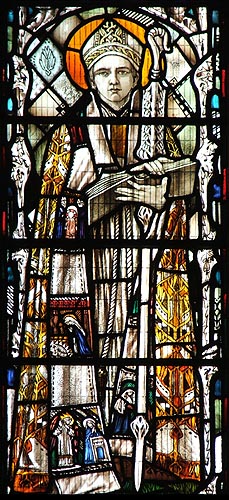
July 15th, Translation of Saint Swithun, Bishop and Confessor


Translation of Saint Swithun, Bishop and Confessor


Swithun entered the monastery of Winchester, and became a priest therein. King Egbert of the West Saxons heard of his fame and gave his son Ethelwulf into his care ; and when this prince years afterwards succeeded to the kingdom, he nominated Swithun Bishop of Winchester, with the consent of the Archbishop of Canterbury and his clergy. Thereafter, in his duty towards his See, Swithun left nothing undone which is the part of a faithful shepherd. * He shrank from all display and gaining of glory in the sight of men, and desired nothing more than that all the good which he did should be unknown save to God and to his own conscience. When he was dying, (to wit, on July 2nd, 862,) he expressed the wish that his body should be laid in the earth outside the church, under the open sky, that the feet of them that came thither might pass over him, and that the rain and the dew might fall upon him ; and his lowly wish was carried out. * Wherefrom hath spring the belief that because of his love of both sunshine and rain, God doth ever grant his request for either, whichever he preferreth for his feast day, and for forty days continuously thereafter. But when the new Cathedral Church of Winchester was built, the relicks of blessed Swithun were translated thereto, to wit, in 1093.

Collect:

Almighty and everlasting God, who hast made this day honorable unto us by reason of the festival of blessed Swithun thy Confessor and Bishop : grant, we beseech thee, that thy Church may so rejoice in this solemnity, that e which on this day do honour him on earth may by his intercession obtain thy succour in heaven, through Jesus Christ thy Son our Lord, who liveth and reigneth with thee and the Holy Ghost, one God, world without end. Amen.

Friday, July 15, 2011

July 15th, Saint Henry, Emperor and Confessor

Saint Henry, Emperor and Confessor.


Henry II, surnamed the Good, was born in 972, and became successively Duke of Bavaria, King of Germany, and Emperor of the Holy Roman Empire, of which he was one of the best and holiest of rulers.  Some say that he once wished to become a monk, and vowed obedience to the Abbot of Verdun ; whereupon the Abbot put him under obedience to retain his royal power, and use it always for the extension of God's kingdom.  As Emperor, he earnestly set himself to the furtherance of the cause of godliness.  He restored churches which had been ruined, built and endowed monasteries, founded new dioceses, and ordered various synods of bishops to assemble, and legislate for the better ordering of things ecclesiastical.  * He waged many wars, some against oppressors of the Church, some for the consolidation of the Empire, but all against injustice.  He made frequent visitations throughout his dominions to relieve the poor, prevent oppressions, and enquire into public abuses.  But he never forgot that governance of himself was his first obligation, and so he never undertook anything until he made it a subject of prayer.  Once in battle he is said to have seen, leading his army, the Angel of the Lord, and his own patrons Saints Lawrence, George, and Adrian, under whose protection he had placed his soldiers. * He gave his sister in marriage to King Stephen of Hungary, to whom his example and friendship was of much worth, for Stephen grew in holiness, and is revered as the Saint who brought the Hungarians to Christ.  Henry himself wedded the maiden Cunegunda, who is commemorated in the Martyrology on March 3rd, and revered as a virgin-Saint ; for it is believed that before their marriage they both vowed themselves to virginity.  The perfume of his holy life spread its sweetness far and wide, and the glory of his holiness outshone the splendour of his crown.  When the work of his life was done, he was called by the Lord to the possession of an eternal kingdom, namely, on July 13th, 1024, and his body was buried in the Church of Saints Peter and Paul at Bamberg.  In 1146 he was numbered among the Saints.


Collect:
O God, who as on this day didst cause thy blessed Confessor Saint Henry to9 pass from the crown of earthly empire to thy everlasting kingdom : we humbly beseech thee, that as by the abundance of thy grace preventing him, thou didst enable him to overcome the temptations of this life, so thou wouldest suffer us, following his pattern, to avoid the deceits of this world, and in perfect purity of heart to attain unto thee, through Jesus Christ our Lord. Amen.