Welcome!

Thanks for visiting my blog! I hope it will serve to inspire you and perhaps inform you in some small way regarding the Holy Orthodox Faith or our Lord Jesus Christ. Feel free to comment or ask questions. Christ be with you!

Thursday, September 30, 2010

Saint Jerome, Priest, Confessor and Doctor, 420

Jerome, who is reckoned among the four first Doctors of the West was the son of one Eusebius, and was born at Stridonium, a small town upon the confines of Dalmatia, about the year 342. He was baptized at Rome sometime after his eighteenth birthday, having been a catechumen up to that time. And in Rome he studied under the instruction of the famous pagan grammarian Donatus, and other very learned personages. He traveled in Gaul for the sake of improving his mind, and there sought the friendship of divers godly men learned in the Scriptures, and made with his own hand many copies of holy books. He afterwards betook himself to Grecian Asia Minor, where he attained eminence as a philosopher and orator, in the following of the most famous theologians. At Constantinople, in especial, he sat at the feet of Saint Gregory of Nazianzus, from whom he professeth himself to have learnt his theology. Then, for godliness sake, he went to see the home of the Lord Christ, and so throughout all Palestine. He witnesseth that this pilgrimage, wherein he got the help of the most learned of the Jews for the understanding of the Holy Scriptures, did him much good.
He withdrew himself into the wild deserts of Syria, where he passed four years in studying the Bible, meanwhile neglecting in no wise constant meditation and prayer, and the meditation and prayer, and the mortification of his body in self-denial and chastisement of the flesh. As a special penance, he learnt Hebrew. By Paulinus, Patriarch of Antioch, he was finally ordained priest against his own inclination. Thereafter he went to Rome on account of the quarrelling of certain bishops with the aforesaid Paulinus. There, with Saint Epiphanius, he helped Pope Saint Damasus in the writing of his letters upon Church affairs. But the longing for his old solitude came upon him. And he went back to Palestine, where, in the monastery at Bethlehem, built beside the cradle of the Lord Christ by the Lady Paula of Rome, he set himself to enter on earth the life of heaven serving God in reading and writing without ceasing, regardless of the sufferings of a body tormented by divers diseases and pains, to which he added a most harsh treatment of himself for his sins, specially for his sharp tongue. For he never was a lover of moderation, either in virtue or against vice. For he never was a lover of moderation, either in virtue or against vice.
Hard questions upon the interpretation of the Holy Scripture were sent to him from all parts of the earth, as to an oracle. He was oftentimes consulted by Pope Saint Damasus, or by the holy Doctor Augustine, upon the meaning of the most obscure passages of the Scripture because of his extraordinary learning, and his knowledge, not only of the Latin and Greek tongues, but also of Hebrew and Chaldee ; for, as the same Augustine testifieth, he has read nearly all writers. He ever undertook the defence of the godly and Catholic, as he himself testifieth : I never spared hereticks, and have always done mine utmost to make the enemies of the Church mine own enemies. In his time there was in use a Latin version of the Bible which is now called The Vetus, the Old Testament whereof was based on the Greek Septuagint. Jerome made a new version, now known as the Vulgate ; for he translated the Old Testament from Hebrew into Latin, and reformed, according to the original Greek, the existing version the New. Upon a great part of the Scriptures he wrote commentaries. He translated likewise into Latin the works of many learned men, and himself contributed to the Christian life many monuments of his own wit. He lived to an extreme old age, and passed away to heaven, famous for learning and holiness, in the reign of the Emperor Honorius, upon September 30th, in the year of our Lord 420. His body was buried at Bethlehem, but afterwards was brought to Rome, where it is now, in the Church of Saint Mary-at-the-Manger.

Antiphon on the Benedictus:
Well done, good and faithful servant: + thou hast been faithful over a few things, I will make thee ruler over many things: * enter thou into the joy of thy Lord (Alleluia.)
Collect:
O GOD, who for the exposition of thy holy Scriptures didst bestow upon thy Church the wondrous teaching of blessed Jerome thy Confessor and Doctor: grant, we beseech thee; that by the intercession of his merits, we may of thee be enabled to perform those things which he taught in word and deed. Through Jesus Christ thy Son our Lord, who liveth and reigneth with thee and the Holy Ghost, one God, world without end. Amen.

Wednesday, September 29, 2010

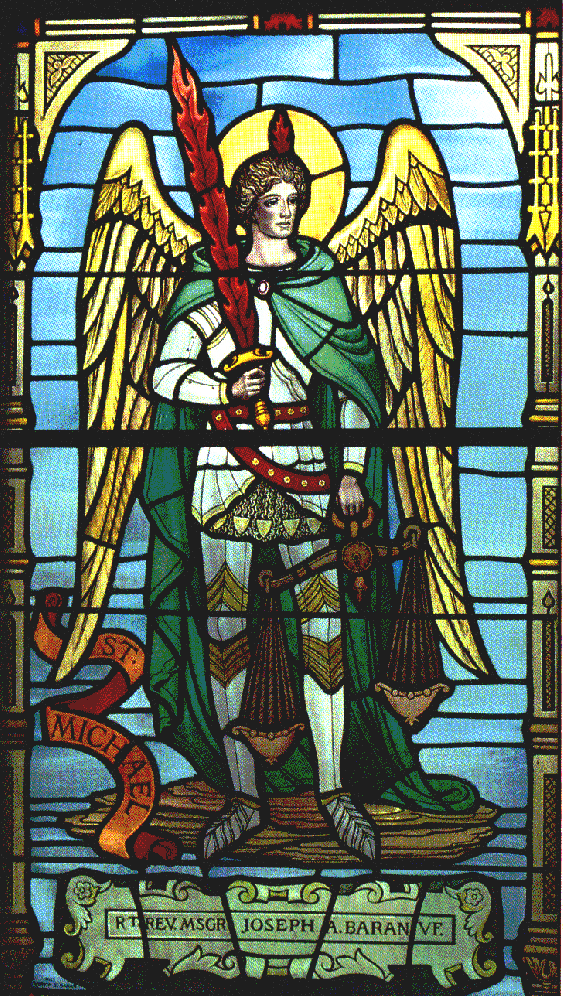
St. Michael and All Angels

St. Michael and All Angels
From a sermon by St. Gregory the Pope
We are accustomed to speak of nine choirs of Angels, because holy Writ seemeth to witness to that number when it speaketh severally of Angels, Archangels, Mights, Powers, Principalities, Dominions, Thrones, Cherubim and Seraphim. Very many pages of holy Writ witness to Angels and Archangels. The books of the Prophets, as is well known, do often make mention of Cherubim and Seraphim. Paul, writing to the Ephesians, counteth up the names of four choirs, where he saith that Christ is set far above all Principality, and Power, and Might, and Dominion. Again, writing to the Colossians, he speaketh of Thrones as well as of Dominions, Principalities, and Powers. If then we add the Thrones to the four choirs mentioned to the Ephesians, we have five choirs. And when we add unto them the Angels and Archangels, the Cherubim and the Seraphim, we com to the final conclusion that there are nine choirs of Angels.
Now it must be understood that the word Angel is the name of an office rather than the designation of the nature of these beings. For those holy ones of heaven are always spirits, but they are not always accurately called Angels, which is, being interpreted, Messengers, for they are Angels only when they are sent as Messengers. Hence also it is said by the Psalmist : He maketh his Angels spirits, and his Ministers : as if to indicate that he hath made them spirits, and that of these spirits he sometimes maketh some to minister in the office of messenger. They that go on a lesser ambassage are called Angels, that is Messengers. They that go on a great ambassage are called Archangels, that is Chief Messengers. Hence it is that unto the Virgin Mary was sent no common Angel, but the Archangel Gabriel. For the delivery of this, the highest message, it was meet that there should be sent one of the highest Angels. Their individual names also are so given as to signify the kind of ministry wherein each is powerful. Michael is by interpretation : Who is like unto God? Gabriel: The Strength of God. Raphael : the Medicine of God. As often as anything very mighty is to be done, we see that Michael is sent, that by that very thing, and by his name, we may remember that none is able to do as God doeth. Hence that old enemy, whose pride hath puffed him up, so that he is fain to be like unto God, is reported by the Prophet Isaiah to have said : I will ascend into heaven; I will exalt my throne above the stars of God; I will be like the Most High. But this old enemy, when at the end of the world he is about to perish in the last death, having no strength but his own, is shewn unto us a-fighting with Michael the Archangel, even as saith John in the Apocalypse : There was war in heaven ; Michael and his Angels fought against the dragon ; and the dragon fought and his angels. Unto Mary is sent Gabriel, whose name signifieth Strength of God, for he came to herald the coming him who was content to appear lowly that he might fight down the powers of the air. Raphael, whose name signifieth Medicine of God, is the one who, as a physician, treated the eyes of Tobit, so that his blindness was cleared away.
 
Antiphon on the Benedictus:
There was silence in heaven for a space, whenas Michael and his Angels made war against the dragon, * and Michael waxed valiant in fight, and turned to flight the armies of the contrary part (Alleluia)
Collect:
O EVERLASTING God, who hast ordained and constituted the services of Angels and men in a wonderful order; Mercifully grant that, as thy holy Angels always do thee service in heaven, so, by thy appointment, they may succour and defend us on earth; through Jesus Christ our Lord. Amen.
 

Tuesday, September 28, 2010

September 28, Wenceslas, Duke of Bohemia, M, (929)

Wenceslas, Duke of Bohemia, was called of God to the hard task of defending Christianity when his subjects were just beginning to learn the Faith, and the devil’s hatred thereof was first being manifested. He was the son of a Christian father, Duke Wratislas I, and a mother, named Drahomira, who was Christian only in name. But he had in his paternal grandmother a most holy foster-mother, namely Saint Ludmilla, who trained him up in godliness. Therefore, he became a man eminent in all graces, and one who carefully kept chastity unsullied throughout the whole course of his life, and in the midst of great wickedness.
After his father’s death, his mother seized the supreme power through the foul murder of Ludmilla, and did all that she could to extirpate Christianity. But some of the nobles, wearied with her tyranny and wicked government, cast off her yoke, and hailed Wenceslas, in the city of Prague, as their ruler. At once he issued a proclamation that he would rule justly, but with mercy, and he did. To the orphaned, the widowed, and the destitute he was very charitable, so that sometimes in the winter he carried firewood to the needy on his own shoulders. He helped oftentimes to bury the poor; he set captives free ; and at the dead of night he went many times to the prisons to comfort with money and advice them that were detained therein. To a prince of so tender an heart it was a great grief to be behoven to condemn any to death, however guilty. For the Church and her clergy he had a most earnest respect, and it was his pleasure to sow and reap the corn, and press the grapes, with his own hands, wherewith to provide for the holy sacrifice. When Tadislas, Prince of Gurinna, invaded Bohemia, Wenceslas, to save the bloodshed of many, went out to meet him in single combat. Faced with such courage and goodness, his enemy bowed in reverence before him, and made with him a league of friendship. When he went to Germany, the Emperor was so impressed with his evident holiness that he arose from his throne, embraced him in his arms, decorated him with the insignia of royalty, and gifted him with relicks of the holy Martyr Vitus. Nevertheless, his godless brother, at the exhortation of their mother, sought him out in a church, where he was praying, thinking to kill him. There this unnatural brother, Boleslas, together with some accomplices in crime, wounded him with their swords. And then Boleslas despatched him with his own hand, running him through the body with a lance. He suffered a little after midnight on September 28th, 935. At once he was acclaimed by the people as a Martyr who had given his life to uphold the Faith against pagan opposition ; and since about the year 985 his feast hath been observed in Bohemia. He is considered the national patron of the Czechs.


St. Exuperius of Tolouse, BC,(410)
St. Eustochium Julia of Rome, V, (420)
St. Lioba of Mainz, V, (781)
Collect: O God, who through the victory of martyrdom didst exalt thy blessed Saint Wenceslas from his earthly principality to the glory of thy heavenly kingdom: we pray thee, at his intercession, to defend us against all adversities, and to suffer us to rejoice in his eternal fellowship, through Jesus Christ thy Son our Lord, who liveth and reigneth with thee and the Holy Ghost, ever one God, world without end. Amen.

Hymn

Good King Wenceslas look'd out,
On the Feast of Stephen;
When the snow lay round about,
Deep, and crisp, and even:
Brightly shone the moon that night,
Though the frost was cruel,
When a poor man came in sight,
Gath'ring winter fuel.

"Hither page and stand by me,
If thou know'st it, telling,
Yonder peasant, who is he?
Where and what his dwelling?"
"Sire, he lives a good league hence.
Underneath the mountain;
Right against the forest fence,
By Saint Agnes' fountain."

"Bring me flesh, and bring me wine,
Bring me pine-logs hither:
Thou and I will see him dine,
When we bear them thither."
Page and monarch forth they went,
Forth they went together;
Though the rude winds wild lament,
And the bitter weather.

"Sire, the night is darker now,
And the wind blows stronger;
Fails my heart, I know not how,
I can go on longer."
"Mark my footsteps, good my page;
Tread thou in them boldly;
Thou shalt find the winter's rage
Freeze thy blood less coldly."

In his master's steps he trod,
Where the snow lay dinted;
Heat was in the very sod
Which the saint had printed.
Therefore, Christian men, be sure,
Wealth or rank possessing,
Ye who now will bless the poor,
Shall yourselves find blessing.

Monday, September 27, 2010

September 27, Saints Cosmas and Damian, Mm

Saints Cosmas and Damian were eminent physicians in the time of the Emperors Diocletian and Maximian, were brothers, and by race Arabs, but born in Cilicia. And they were wont to give their services to the poor, for which reason in the East they have the title: The Moneyless Ones. When the Prefect Lysias learnt that they were Christians, he commanded them to worship the gods, under threats of torments and death. But when he found that threats could not shake them, he practiced upon them torments by water, by fire, and by other cruelties, and lastly had them beheaded. Thus did they bear witness for Christ Jesus even until they grasped the palm of victory.
Antiphon on the Benedictus:
Even the very hairs of your head are all numbered: * fear not therefore, ye are of more value than many sparrows.
Ss. Cosmas and Damian
Collect :
Grant, we beseech thee, Almighty God, that we, who observe the heavenly birthday of blessed Cosmas and Damian, thy Martyrs, may by their intercession be delivered from all evils that beset us, Through Jesus Christ thy Son our Lord, who liveth and with thee and the Holy Ghost, one God, world without end. Amen.,

Sunday, September 26, 2010

September 26, St. Cyprian and Justina, Mm, Orthodox saints

Many stories are told of Cyprian and the virgin Justina to show the powerlessness of the devil against Christians, who trusted in the might of the Cross. According to these old legends, Cyprian first practiced sorcery, but afterwards lived and practiced the science of the Cross, and so died a martyr. When he was pursuing the evil arts, a young man, who lusted after the Christian maiden Justina, came to him for a love-potion wherewith he might seduce her. Cyprian thereupon sought from the devil some knowledge as to how to accomplish this evil end, but became convinced that all his arts were wasted on any who truly worshipped Christ. Wherefore he became a true Christian believer. For this cause, he and the Virgin Justina were arrested together, beaten with blows and scourging, and cast into prison, if haply they might change their mind. Afterwards they were further tortured, and in the end beheaded, at Nicomedia, on September 26th, in the year 304. Their bodies were thrown out, and lay unburied for the space of six days, at the end of which time some sailors took them secretly by night on board a ship and carried them to Rome, where they are said to be buried hard by the baptistery in the Lateran Basilica.

O Lord, who never failest to look down in mercy on them on whom thou bestowest the succour of thy Saints : grant, we pray thee, that the intercession of the blessed Martyrs Cyprian and Justina, may evermore avail to comfort and defend us, Through Jesus Christ our Lord. Amen.

Collect:

Saturday, September 25, 2010

Saturday's

Saturday's are days that have always gotten sorta lost for me. I mean I often don't do much productive on Saturday's. What are we supposed to do with a Saturday? For me I guess part of the problem is that the type work I like to do focuses and requires mental effort and focus, and with everyone being at home and requiring attention that is a distraction from reading, writing, and so forth.

I did go to Vesper's tonight in preparation for Mass tomorrow. That is a small accomplishment, or certainly something one should do each weekend.
The first lesson tonight was Job chapter two, where Satan presents himself before the Lord at the same time as the "sons of God." Job is an example to us of faithfulness to the Lord in the face of suffering and adversity.
I would hope I could be so steadfast if such things befell me. I fear I don't have that strength and virtue.

Friday, September 24, 2010

Our Lady of Mercy and Ransom, September 24

Our Lady of Mercy and Ransom
In the early part of the thirteenth century, much of Spain lay crushed under the yoke of the Saracens. By whom countless numbers of the faithful were held in brutal slavery, with the lively danger of being made to deny, and so to forfeit, everlasting salvation. Amid such sorrows as these a wealthy and godly man, Peter Nolasco, was earnestly pondering within himself how he could succour so many suffering Christians dwelling in bondage to the Moors. And it is related that the Blessed Virgin appeared to him, and told him that it would be well-pleasing to her Son, if an Order were founded in her honour, for the purpose of redeeming prisoners from their slavery to the infidels. Strengthened by this heavenly vision, the man of God (so it is said ) began to burn with the desire that he himself, and the Order which he should found, might exercise that live, greater than which hath no man, that a man lay down his life for his friends.
Upon the same nigh (so the story hath it) the Virgin also appeared to Saint Raymund of Pennaforte, and to King James of Aragon, charging them concerning the funding of the Order. Now it happened that Peter had for his confessor this same Raymund, to whose governance he right humbly submitted himself. Then came King James, and the three took counsel together, and all with one consent entered upon the institution of an Order, under the invocation of Saint Mary of Ransom, for the redemption of captives.
From lack of historical records, no verification of the foregoing stories is possible, but it is known that Peter Nolasco founded such an Order. The brethren whereof took (in addition to the vows of poverty, chastity, and obedience) a fourth vow, whereby they bound themselves to give themselves in pawn to the unbelievers, if need so required, for the liberation of Christians from their bondage, and this Institute, under the Blessed Virgin’s patronage, spread through all the world. That due thanks might be rendered for the many mighty works which have come to pass form these examples of Christian charity, this Feast of our Lady of Mercy hath been instituted, and is become the titular feast of those works of mercy undertaken under her patronage.

Collect
O God, who through the most glorious Mother of thy Son didst vouchsafe to increase thy Church with a new offspring for the redemption of thy Christian people from the powere of the heathen : grant, we beseech thee, that like as we on this day do honour her for the work of her institution, so by her merits and intercession we may be delivered from all our iniqiuties and the bondage of the devil, through the same thy Son, Jesus Christ our Lord. Amen.